EGYPTIAN
ARCHAEOLOGY
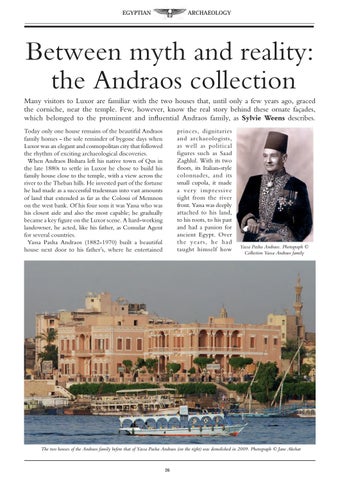
Between myth and reality: the Andraos collection Many visitors to Luxor are familiar with the two houses that, until only a few years ago, graced the corniche, near the temple. Few, however, know the real story behind these ornate façades, which belonged to the prominent and influential Andraos family, as Sylvie Weens describes. princes, dignitaries and archaeologists, as well as political figures such as Saad Zaghlul. With its two floors, its Italian-style colonnades, and its small cupola, it made a ver y impr essive sight from the river front. Yassa was deeply attached to his land, to his roots, to his past and had a passion for ancient Egypt. Over the years, he had taught himself how
Today only one house remains of the beautiful Andraos family homes - the sole reminder of bygone days when Luxor was an elegant and cosmopolitan city that followed the rhythm of exciting archaeological discoveries. When Andraos Bishara left his native town of Qus in the late 1880s to settle in Luxor he chose to build his family house close to the temple, with a view across the river to the Theban hills. He invested part of the fortune he had made as a successful tradesman into vast amounts of land that extended as far as the Colossi of Memnon on the west bank. Of his four sons it was Yassa who was his closest aide and also the most capable; he gradually became a key figure on the Luxor scene. A hard-working landowner, he acted, like his father, as Consular Agent for several countries. Yassa Pasha Andraos (1882-1970) built a beautiful house next door to his father’s, where he entertained
Yassa Pasha Andraos. Photograph © Collection Yassa Andraos family
The two houses of the Andraos family before that of Yassa Pasha Andraos (on the right) was demolished in 2009. Photograph © Jane Akshar
26