EGYPTIAN
ARCHAEOLOGY
Consolidating the remains of the ancient coats of whitewash on the enclosure wall
Years had several overlapping building phases within the reign of Tuthmosis III and further study of the temple is needed. Analysis of the large amount of pottery produced by the excavations will enable us to date more accurately the tombs and any remains from other periods, and also cast more light on the different building phases of this important temple.
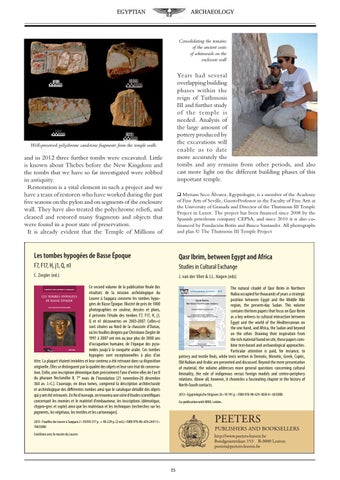
Well-preserved polychrome sandstone fragments from the temple walls
and in 2012 three further tombs were excavated. Little is known about Thebes before the New Kingdom and the tombs that we have so far investigated were robbed in antiquity. Restoration is a vital element in such a project and we have a team of restorers who have worked during the past five seasons on the pylon and on segments of the enclosure wall. They have also treated the polychrome reliefs, and cleaned and restored many fragments and objects that were found in a poor state of preservation. It is already evident that the Temple of Millions of
q Myriam Seco Ă lvarez, Egyptologist, is a member of the Academy of Fine Arts of Seville, Guest-Professor in the Faculty of Fine Arts at the University of Granada and Director of the Thutmosis III Temple Project in Luxor. The project has been financed since 2008 by the Spanish petroleum company CEPSA, and since 2010 it is also cofinanced by FundaciĂłn BotĂn and Banco Santander. All photographs and plan Š The Thutmosis III Temple Project
Les tombes hypogÊes de Basse Époque
Qasr Ibrim, between Egypt and Africa
F7, F17, H, j1, Q, n1
Studies in Cultural Exchange
C. Ziegler (ed.)
+ WBO EFS 7MJFU + - )BHFO FET
Ce second volume de la publication finale des rÊsultats de la mission archÊologique du LES TOMBES HYPOGÉES Louvre à Saqqara concerne les tombes hypoDE BASSE ÉPOQUE gÊes de Basse Époque. IllustrÊ de près de 1000 photographies en couleur, dessins et plans, il prÊsente l’Êtude des tombes F7, F17, H, j1, Q et n1 dÊcouvertes en 2003-2007. Celles-ci sont situÊes au Nord de la chaussÊe d’Ounas, oÚ les fouilles dirigÊes par Christiane Ziegler de 1991 à 2007 ont mis au jour plus de 3000 ans d’occupation humaine, de l’Êpoque des pyramides jusqu’à la conquête arabe. Ces tombes hypogÊes sont exceptionnelles à plus d’un titre. La plupart Êtaient inviolÊes et leur contenu a ÊtÊ retrouvÊ dans sa disposition originelle. Elles se distinguent par la qualitÊ des objets et leur rare Êtat de conservation. Enfin, une inscription dÊmotique date prÊcisÊment l’une d’entre elles de l’an II du pharaon NectanÊbo II, 1er mois de l’inondation (21 novembre-20 dÊcembre 360 av. J.-C.). L’ouvrage, en deux tomes, comprend la description architecturale et archÊologique des diffÊrentes tombes ainsi que le catalogue dÊtaillÊ des objets qui y ont ÊtÊ retrouvÊs. En fin d’ouvrage, on trouvera une sÊrie d’Êtudes scientifiques concernant les momies et le matÊriel d’embaumeur, les inscriptions (dÊmotique, chypro-grec et copte) ainsi que les matÊriaux et les techniques (recherches sur les pigments, les vÊgÊtaux, les textiles et les cartonnages).
The natural citadel of Qasr Ibrim in Northern Nubia occupied for thousands of years a strategic position between Egypt and the Middle Nile Qasr Ibrim, Between Egypt and Africa region, the present-day Sudan. This volume contains thirteen papers that focus on Qasr Ibrim as a key witness to cultural interaction between Egypt and the world of the Mediterranean on the one hand, and Africa, the Sudan and beyond on the other. Drawing their inspiration from the rich material found on site, these papers combine text-based and archaeological approaches. Particular attention is paid, for instance, to pottery and textile finds, while texts written in Demotic, Meroitic, Greek, Coptic, Old Nubian and Arabic are presented and discussed. Beyond the mere presentation of material, the volume addresses more general questions concerning cultural liminality, the role of indigenous versus foreign models and centre-periphery relations. Above all, however, it chronicles a fascinating chapter in the history of North-South contacts.
FOUILLES DU LOUVRE À SAQQARA
&HZQUPMPHJTDIF 6JUHBWFO t 997*
sous la direction de Christiane Ziegler
Studies in Cultural Exchange
J. van der Vliet and J.L. Hagen (eds.) with the assistance of C.H. van Zoest and L.E. van de Peut
Peeters – Leuven Nederlands Instituut voor het Nabije Oosten – Leiden 2013
PEETERS
t &HZQUPMPHJTDIF 6JUHBWFO t 7* Q t *4#/ t &630 Co-publication with NINO, Leiden.
Peeters
t 'PVJMMFT EV -PVWSF Ă‹ 4BRRBSB t 9997* Q 9** Q WPM t *4#/ t 190 EURO
Publishers and booksellers
CoĂŠdition avec le musĂŠe du Louvre.
96120_Adv_EgyptArchĂŚology_179x130mm.indd 1
http://www.peeters-leuven.be bondgenotenlaan 153 b-3000 leuven peeters@peeters-leuven.be
25
13/12/13 11:31