EGYPTIAN
ARCHAEOLOGY
Limestone relief of Tuthmosis III, found in two fragments in the temple
The southern enclosure wall and its attacched structures
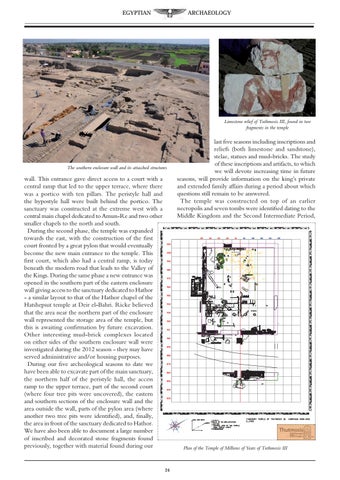
wall. This entrance gave direct access to a court with a central ramp that led to the upper terrace, where there was a portico with ten pillars. The peristyle hall and the hypostyle hall were built behind the portico. The sanctuary was constructed at the extreme west with a central main chapel dedicated to Amun-Re and two other smaller chapels to the north and south. During the second phase, the temple was expanded towards the east, with the construction of the first court fronted by a great pylon that would eventually become the new main entrance to the temple. This first court, which also had a central ramp, is today beneath the modern road that leads to the Valley of the Kings. During the same phase a new entrance was opened in the southern part of the eastern enclosure wall giving access to the sanctuary dedicated to Hathor - a similar layout to that of the Hathor chapel of the Hatshepsut temple at Deir el-Bahri. Ricke believed that the area near the northern part of the enclosure wall represented the storage area of the temple, but this is awaiting confirmation by future excavation. Other interesting mud-brick complexes located on either sides of the southern enclosure wall were investigated during the 2012 season - they may have served administrative and/or housing purposes. During our five archeological seasons to date we have been able to excavate part of the main sanctuary, the northern half of the peristyle hall, the access ramp to the upper terrace, part of the second court (where four tree pits were uncovered), the eastern and southern sections of the enclosure wall and the area outside the wall, parts of the pylon area (where another two tree pits were identified), and, finally, the area in front of the sanctuary dedicated to Hathor. We have also been able to document a large number of inscribed and decorated stone fragments found previously, together with material found during our
last five seasons including inscriptions and reliefs (both limestone and sandstone), stelae, statues and mud-bricks. The study of these inscriptions and artifacts, to which we will devote increasing time in future seasons, will provide information on the king’s private and extended family affairs during a period about which questions still remain to be answered. The temple was constructed on top of an earlier necropolis and seven tombs were identified dating to the Middle Kingdom and the Second Intermediate Period,
Plan of the Temple of Millions of Years of Tuthmosis III
24