EGYPTIAN
ARCHAEOLOGY
The Temple of Millions of Years of Tuthmosis III In 2008 an Egyptian/Spanish project was initiated to study and document the remains of the Temple of Millions of Years of Tuthmosis III, located about 100m north of the Ramesseum, between the cultivation and the desert. Myriam Seco Álvarez summarises the results of the first five seasons. The aims of this collaborative project of the Egyptian Ministry of State for Antiquities (MSA) and the Academy of Fine Arts Santa Isabel de Hungría in Seville include excavation, restoration and site-management. We have undertaken three-month seasons in autumn each year since 2008 and have made significant progress in different fields of investigation. The first archaeologist to excavate the Temple of Millions of Years of Tuthmosis III was Georges Daressy who, in the winter of 1888-89, undertook a one-month campaign. His excavation focused mainly on the upper terrace and the northern zone adjacent to the mud-brick enclosure wall, where there was a series of mud-brick rooms that he considered to be the storage area of the temple. In 1905 Arthur Weigall also investigated the temple during one campaign. He defined the layout of the whole temple, including the storage area at the north and one tomb (which predated the temple) located under the southern enclosure wall. In his published archaeological report he listed a large number of blocks, some of which we were able to identify during our first season in a magazine he built on the site. The last study of the temple before
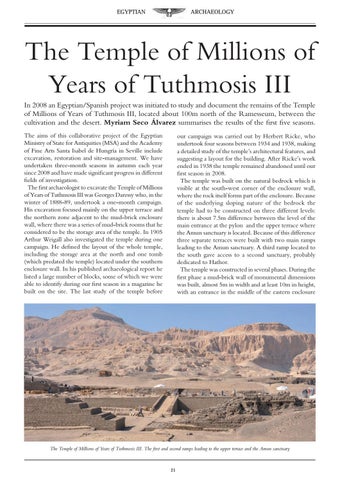
our campaign was carried out by Herbert Ricke, who undertook four seasons between 1934 and 1938, making a detailed study of the temple’s architectural features, and suggesting a layout for the building. After Ricke’s work ended in 1938 the temple remained abandoned until our first season in 2008. The temple was built on the natural bedrock which is visible at the south-west corner of the enclosure wall, where the rock itself forms part of the enclosure. Because of the underlying sloping nature of the bedrock the temple had to be constructed on three different levels: there is about 7.5m difference between the level of the main entrance at the pylon and the upper terrace where the Amun sanctuary is located. Because of this difference three separate terraces were built with two main ramps leading to the Amun sanctuary. A third ramp located to the south gave access to a second sanctuary, probably dedicated to Hathor. The temple was constructed in several phases. During the first phase a mud-brick wall of monumental dimensions was built, almost 5m in width and at least 10m in height, with an entrance in the middle of the eastern enclosure
The Temple of Millions of Years of Tuthmosis III. The first and second ramps leading to the upper terrace and the Amun sanctuary
21