EGYPTIAN
ARCHAEOLOGY
not far from his place of residence, Girga, which must also have been the centre of his professional activities, though their exact nature is still unknown. In a document dated 1913 he refers to his recent responsibilities in creating cotton fields, but this does not mean that this had been his work four decades earlier. Each graffito has several dates under his name testifying to regular visits to the temples. Of particular interest is the coincidence of years with two trips by Abargues to Spain in 1877 and 1879, in economic times which were so critical that the Egyptian government was unable to pay wages to its employees. On each visit he sold a small collection of antiquities to the National Archaeological Museum in Madrid. They amount to more than 200 small objects (amulets, scarabs, bronze statuettes, etc.) and 100 coins. The inventory for each sale details their origins: mainly Abydos, Luxor, Dendera and Edfu. The identification of Abargues as the writer of the two graffiti means that the pieces should be re-examined and doubts formerly expressed over the authenticity of some objects might need to be revised. In 1877 he also donated 24 squeezes to the Royal Academy of Fine Arts in Madrid. Today they are lost, but plaster casts were made and thirteen different ones
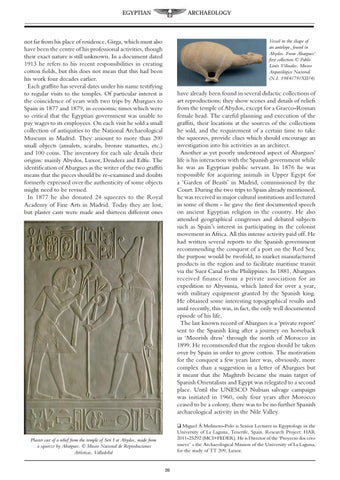
Vessel in the shape of an antelope, found in Abydos. From Abargues’ first collection © Pablo Linés Viñuales. Museo Arqueológico Nacional (N.I. 1984/79/XII/4)
have already been found in several didactic collections of art reproductions; they show scenes and details of reliefs from the temple of Abydos, except for a Graeco-Roman female head. The careful planning and execution of the graffiti, their locations at the sources of the collections he sold, and the requirement of a certain time to take the squeezes, provide clues which should encourage an investigation into his activities as an architect. Another as yet poorly understood aspect of Abargues’ life is his interaction with the Spanish government while he was an Egyptian public servant. In 1876 he was responsible for acquiring animals in Upper Egypt for a ‘Garden of Beasts’ in Madrid, commissioned by the Court. During the two trips to Spain already mentioned, he was received in major cultural institutions and lectured in some of them - he gave the first documented speech on ancient Egyptian religion in the country. He also attended geographical congresses and debated subjects such as Spain’s interest in participating in the colonist movement in Africa. All this intense activity paid off. He had written several reports to the Spanish government recommending the conquest of a port on the Red Sea; the purpose would be twofold, to market manufactured products in the region and to facilitate maritime transit via the Suez Canal to the Philippines. In 1881, Abargues received finance from a private association for an expedition to Abyssinia, which lasted for over a year, with military equipment granted by the Spanish king. He obtained some interesting topographical results and until recently, this was, in fact, the only well documented episode of his life. The last known record of Abargues is a ‘private report’ sent to the Spanish king after a journey on horseback in ‘Moorish dress’ through the north of Morocco in 1899. He recommended that the region should be taken over by Spain in order to grow cotton. The motivation for the conquest a few years later was, obviously, more complex than a suggestion in a letter of Abargues but it meant that the Maghreb became the main target of Spanish Orientalism and Egypt was relegated to a second place. Until the UNESCO Nubian salvage campaign was initiated in 1960, only four years after Morocco ceased to be a colony, there was to be no further Spanish archaeological activity in the Nile Valley. q Miguel Á Molinero-Polo is Senior Lecturer in Egyptology in the University of La Laguna, Tenerife, Spain. Research Project: HAR 2011-25292 (MCI+FEDER). He is Director of the ‘Proyecto dos cero nueve’ - the Archaeological Mission of the University of La Laguna, for the study of TT 209, Luxor.
Plaster cast of a relief from the temple of Seti I at Abydos, made from a squeeze by Abargues. © Museo Nacional de Reproducciones Artísticas, Valladolid 20