EGYPTIAN
ARCHAEOLOGY
Two enigmatic graffiti In the late nineteenth century a hitherto little known Spanish architect left two graffiti at Abydos and Dendera. Miguel Á Molinero-Polo places them in their historical and cultural contexts. architect Antonio Amador de los Rios who helped the Marquis de Rochemonteix in his work at the temple of Edfu. At the same time, Egyptian history books were written, to be used as manuals for college classes. In the following decade, Eduard Toda, the vice-consul in Cairo, created the largest private collection of Egyptian antiquities to be sent to Spain; he was advised by Egyptologists of the Service des Antiquités, with whom he had a close friendship. This also explains his supervision of the removal of Sennedjem’s funerary equipment when this tomb was discovered - the first Spanish archaeological activity on Egyptian soil. However, the crisis provoked in the 1890s by the independence of the last colonies of the former Spanish Empire ended the hope of developing Egyptology as an academic subject in Spain. In 1899, a state project for the creation of chairs of Oriental languages, including ancient Egyptian, was annulled. Funding provided by Vicente de Galarza for the excavation of a tomb at Giza was the swan-song of these four decades. Abargues was born in Algiers where he must have learnt Arabic in his childhood, arriving in 1872 in Egypt where he lived until 1916. It is not known under what conditions he was hired as an architect by the Egyptian government but he was only twenty-two years old, so this must have been one of his first jobs. The two graffiti are
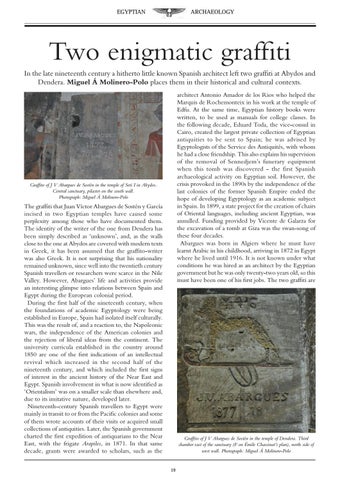
Graffito of J V Abargues de Sostén in the temple of Seti I in Abydos. Central sanctuary, pilaster on the south wall. Photograph: Miguel Á Molinero-Polo
The graffiti that Juan Víctor Abargues de Sostén y García incised in two Egyptian temples have caused some perplexity among those who have documented them. The identity of the writer of the one from Dendera has been simply described as ‘unknown’, and, as the walls close to the one at Abydos are covered with modern texts in Greek, it has been assumed that the graffito-writer was also Greek. It is not surprising that his nationality remained unknown, since well into the twentieth century Spanish travellers or researchers were scarce in the Nile Valley. However, Abargues’ life and activities provide an interesting glimpse into relations between Spain and Egypt during the European colonial period. During the first half of the nineteenth century, when the foundations of academic Egyptology were being established in Europe, Spain had isolated itself culturally. This was the result of, and a reaction to, the Napoleonic wars, the independence of the American colonies and the rejection of liberal ideas from the continent. The university curricula established in the country around 1850 are one of the first indications of an intellectual revival which increased in the second half of the nineteenth century, and which included the first signs of interest in the ancient history of the Near East and Egypt. Spanish involvement in what is now identified as ‘Orientalism’ was on a smaller scale than elsewhere and, due to its imitative nature, developed later. Nineteenth-century Spanish travellers to Egypt were mainly in transit to or from the Pacific colonies and some of them wrote accounts of their visits or acquired small collections of antiquities. Later, the Spanish government charted the first expedition of antiquarians to the Near East, with the frigate Arapiles, in 1871. In that same decade, grants were awarded to scholars, such as the
Graffito of J V Abargues de Sostén in the temple of Dendera. Third chamber east of the sanctuary (F on Émile Chassinat’s plan), north side of west wall. Photograph: Miguel Á Molinero-Polo 19