EGYPTIAN
ARCHAEOLOGY
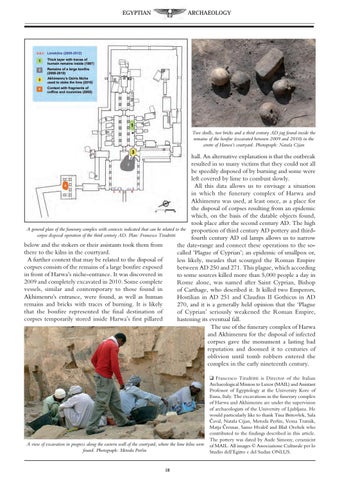
Two skulls, two bricks and a third century AD jug found inside the remains of the bonfire (excavated between 2009 and 2010) in the centre of Harwa’s courtyard. Photograph: Nataša Cijan
hall. An alternative explanation is that the outbreak resulted in so many victims that they could not all be speedily disposed of by burning and some were left covered by lime to combust slowly. All this data allows us to envisage a situation in which the funerary complex of Harwa and Akhimenru was used, at least once, as a place for the disposal of corpses resulting from an epidemic which, on the basis of the datable objects found, took place after the second century AD. The high A general plan of the funerary complex with contexts indicated that can be related to the proportion of third century AD pottery and thirdcorpse disposal operation of the third century AD. Plan: Francesco Tiradritti fourth century AD oil lamps allows us to narrow below and the stokers or their assistants took them from the date-range and connect these operations to the sothere to the kilns in the courtyard. called ‘Plague of Cyprian’; an epidemic of smallpox or, A further context that may be related to the disposal of less likely, measles that scourged the Roman Empire corpses consists of the remains of a large bonfire exposed between AD 250 and 271. This plague, which according in front of Harwa’s niche-entrance. It was discovered in to some sources killed more than 5,000 people a day in 2009 and completely excavated in 2010. Some complete Rome alone, was named after Saint Cyprian, Bishop vessels, similar and contemporary to those found in of Carthage, who described it. It killed two Emperors, Akhimenru’s entrance, were found, as well as human Hostilian in AD 251 and Claudius II Gothicus in AD remains and bricks with traces of burning. It is likely 270, and it is a generally held opinion that the ‘Plague that the bonfire represented the final destination of of Cyprian’ seriously weakened the Roman Empire, corpses temporarily stored inside Harwa’s first pillared hastening its eventual fall. The use of the funerary complex of Harwa and Akhimenru for the disposal of infected corpses gave the monument a lasting bad reputation and doomed it to centuries of oblivion until tomb robbers entered the complex in the early nineteenth century.
A view of excavation in progress along the eastern wall of the courtyard, where the lime kilns were found. Photograph: Metoda Peršin
18
q Francesco Tiradritti is Director of the Italian Archaeological Mission to Luxor (MAIL) and Assistant Professor of Egyptology at the University Kore of Enna, Italy. The excavations in the funerary complex of Harwa and Akhimenru are under the supervision of archaeologists of the University of Ljubljana. He would particularly like to thank Tina Britovšek, Saša Čaval, Nataša Cijan, Metoda Peršin, Vesna Tratnik, Matja Čresnar, Samo Hvaleč and Blaž Orehek who contributed to the findings described in this article. The pottery was dated by Aude Simony, ceramicist of MAIL. All images © Associazione Culturale per lo Studio dell’Egitto e del Sudan ONLUS.