EGYPTIAN
ARCHAEOLOGY
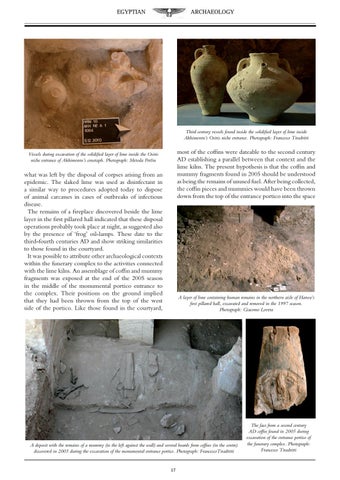
Third century vessels found inside the solidified layer of lime inside Akhimenru’s Osiris niche entrance. Photograph: Francesco Tiradritti
most of the coffins were dateable to the second century AD establishing a parallel between that context and the lime kilns. The present hypothesis is that the coffin and mummy fragments found in 2005 should be understood as being the remains of unused fuel. After being collected, the coffin pieces and mummies would have been thrown down from the top of the entrance portico into the space
Vessels during excavation of the solidified layer of lime inside the Osiris niche entrance of Akhimenru’s cenotaph. Photograph: Metoda Peršin
what was left by the disposal of corpses arising from an epidemic. The slaked lime was used as disinfectant in a similar way to procedures adopted today to dispose of animal carcasses in cases of outbreaks of infectious disease. The remains of a fireplace discovered beside the lime layer in the first pillared hall indicated that these disposal operations probably took place at night, as suggested also by the presence of ‘frog’ oil-lamps. These date to the third-fourth centuries AD and show striking similarities to those found in the courtyard. It was possible to attribute other archaeological contexts within the funerary complex to the activities connected with the lime kilns. An assemblage of coffin and mummy fragments was exposed at the end of the 2005 season in the middle of the monumental portico entrance to the complex. Their positions on the ground implied that they had been thrown from the top of the west side of the portico. Like those found in the courtyard,
A layer of lime containing human remains in the northern aisle of Harwa’s first pillared hall, excavated and removed in the 1997 season. Photograph: Giacomo Lovera
A deposit with the remains of a mummy (to the left against the wall) and several boards from coffins (in the centre) discovered in 2005 during the excavation of the monumental entrance portico. Photograph: FrancescoTiradritti 17
The face from a second century AD coffin found in 2005 during excavation of the entrance portico of the funerary complex. Photograph: Francesco Tiradritti