EGYPTIAN
ARCHAEOLOGY
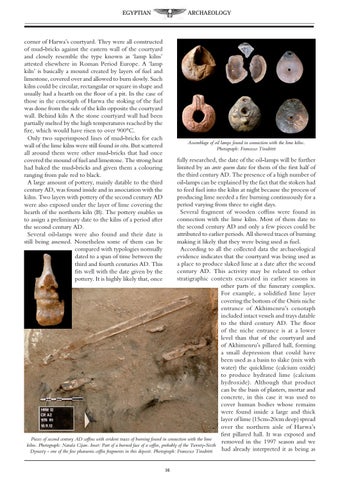
corner of Harwa’s courtyard. They were all constructed of mud-bricks against the eastern wall of the courtyard and closely resemble the type known as ‘lamp kilns’ attested elsewhere in Roman Period Europe. A ‘lamp kiln’ is basically a mound created by layers of fuel and limestone, covered over and allowed to burn slowly. Such kilns could be circular, rectangular or square in shape and usually had a hearth on the floor of a pit. In the case of those in the cenotaph of Harwa the stoking of the fuel was done from the side of the kiln opposite the courtyard wall. Behind kiln A the stone courtyard wall had been partially melted by the high temperatures reached by the fire, which would have risen to over 900°C. Only two superimposed lines of mud-bricks for each wall of the lime kilns were still found in situ. But scattered all around them were other mud-bricks that had once covered the mound of fuel and limestone. The strong heat had baked the mud-bricks and given them a colouring ranging from pale red to black. A large amount of pottery, mainly datable to the third century AD, was found inside and in association with the kilns. Two layers with pottery of the second century AD were also exposed under the layer of lime covering the hearth of the northern kiln (B). The pottery enables us to assign a preliminary date to the kilns of a period after the second century AD. Several oil-lamps were also found and their date is still being assessed. Nonetheless some of them can be compared with typologies normally dated to a span of time between the third and fourth centuries AD. This fits well with the date given by the pottery. It is highly likely that, once
Assemblage of oil lamps found in connection with the lime kilns. Photograph: Francesco Tiradritti
fully researched, the date of the oil-lamps will be further limited by an ante quem date for them of the first half of the third century AD. The presence of a high number of oil-lamps can be explained by the fact that the stokers had to feed fuel into the kilns at night because the process of producing lime needed a fire burning continuously for a period varying from three to eight days. Several fragment of wooden coffins were found in connection with the lime kilns. Most of them date to the second century AD and only a few pieces could be attributed to earlier periods. All showed traces of burning making it likely that they were being used as fuel. According to all the collected data the archaeological evidence indicates that the courtyard was being used as a place to produce slaked lime at a date after the second century AD. This activity may be related to other stratigraphic contexts excavated in earlier seasons in other parts of the funerary complex. For example, a solidified lime layer covering the bottom of the Osiris niche entrance of Akhimenru’s cenotaph included intact vessels and trays datable to the third century AD. The floor of the niche entrance is at a lower level than that of the courtyard and of Akhimenru’s pillared hall, forming a small depression that could have been used as a basin to slake (mix with water) the quicklime (calcium oxide) to produce hydrated lime (calcium hydroxide). Although that product can be the basis of plasters, mortar and concrete, in this case it was used to cover human bodies whose remains were found inside a large and thick layer of lime (15cm-20cm deep) spread over the northern aisle of Harwa’s first pillared hall. It was exposed and Pieces of second century AD coffins with evident traces of burning found in connection with the lime removed in the 1997 season and we kilns. Photograph: Nataša Cijan. Inset: Part of a burned face of a coffin, probably of the Twenty-Sixth had already interpreted it as being as Dynasty - one of the few pharaonic coffin fragments in this deposit. Photograph: Francesco Tiradritti 16