EGYPTIAN
ARCHAEOLOGY
Of kilns and corpses: Theban plague victims In the third century AD the funerary complex of Harwa (TT 37) and Akhimenru (TT 404) on the west bank at Thebes was used to dispose of the bodies of plague victims. Francesco Tiradritti describes the archaeological context. A decorated fragment found inside one of the kilns and here virtually replaced in its original position at the entrance to Akhimenru’s cenotaph. Photographs and virtual reconstruction: Francesco Tiradritti
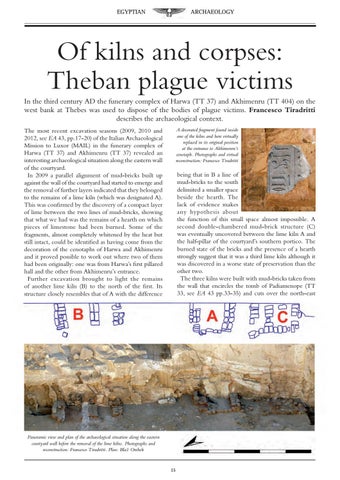
The most recent excavation seasons (2009, 2010 and 2012, see EA 43, pp.17-20) of the Italian Archaeological Mission to Luxor (MAIL) in the funerary complex of Harwa (TT 37) and Akhimenru (TT 37) revealed an interesting archaeological situation along the eastern wall of the courtyard. In 2009 a parallel alignment of mud-bricks built up against the wall of the courtyard had started to emerge and the removal of further layers indicated that they belonged to the remains of a lime kiln (which was designated A). This was confirmed by the discovery of a compact layer of lime between the two lines of mud-bricks, showing that what we had was the remains of a hearth on which pieces of limestone had been burned. Some of the fragments, almost completely whitened by the heat but still intact, could be identified as having come from the decoration of the cenotaphs of Harwa and Akhimenru and it proved possible to work out where two of them had been originally: one was from Harwa’s first pillared hall and the other from Akhimenru’s entrance. Further excavation brought to light the remains of another lime kiln (B) to the north of the first. Its structure closely resembles that of A with the difference
being that in B a line of mud-bricks to the south delimited a smaller space beside the hearth. The lack of evidence makes any hypothesis about the function of this small space almost impossible. A second double-chambered mud-brick structure (C) was eventually uncovered between the lime kiln A and the half-pillar of the courtyard’s southern portico. The burned state of the bricks and the presence of a hearth strongly suggest that it was a third lime kiln although it was discovered in a worse state of preservation than the other two. The three kilns were built with mud-bricks taken from the wall that encircles the tomb of Padiamenope (TT 33, see EA 43 pp.33-35) and cuts over the north-east
Panoramic view and plan of the archaeological situation along the eastern courtyard wall before the removal of the lime kilns. Photographs and reconstruction: Francesco Tiradritti. Plan: Blaž Orehek
15