EGYPTIAN
ARCHAEOLOGY
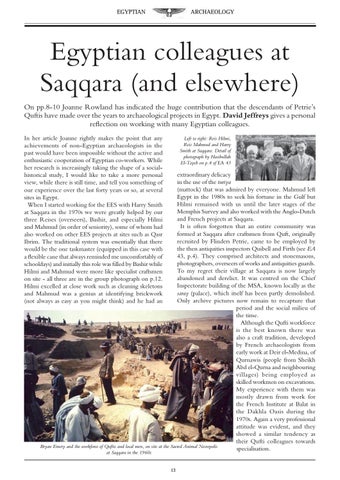
Egyptian colleagues at Saqqara (and elsewhere) On pp.8-10 Joanne Rowland has indicated the huge contribution that the descendants of Petrie’s Quftis have made over the years to archaeological projects in Egypt. David Jeffreys gives a personal reflection on working with many Egyptian colleagues. In her article Joanne rightly makes the point that any achievements of non-Egyptian archaeologists in the past would have been impossible without the active and enthusiastic cooperation of Egyptian co-workers. While her research is increasingly taking the shape of a socialhistorical study, I would like to take a more personal view, while there is still time, and tell you something of our experience over the last forty years or so, at several sites in Egypt. When I started working for the EES with Harry Smith at Saqqara in the 1970s we were greatly helped by our three Reises (overseers), Bashir, and especially Hilmi and Mahmud (in order of seniority), some of whom had also worked on other EES projects at sites such as Qasr Ibrim. The traditional system was essentially that there would be the one taskmaster (equipped in this case with a flexible cane that always reminded me uncomfortably of schooldays) and initially this role was filled by Bashir while Hilmi and Mahmud were more like specialist craftsmen on site - all three are in the group photograph on p.12. Hilmi excelled at close work such as cleaning skeletons and Mahmud was a genius at identifying brickwork (not always as easy as you might think) and he had an
Left to right: Reis Hilmi, Reis Mahmud and Harry Smith at Saqqara. Detail of photograph by Hasibullah El-Tayeb on p.4 of EA 43
extraordinary delicacy in the use of the turiya (mattock) that was admired by everyone. Mahmud left Egypt in the 1980s to seek his fortune in the Gulf but Hilmi remained with us until the later stages of the Memphis Survey and also worked with the Anglo-Dutch and French projects at Saqqara. It is often forgotten that an entire community was formed at Saqqara after craftsmen from Quft, originally recruited by Flinders Petrie, came to be employed by the then antiquities inspectors Quibell and Firth (see EA 43, p.4). They comprised architects and stonemasons, photographers, overseers of works and antiquities guards. To my regret their village at Saqqara is now largely abandoned and derelict. It was centred on the Chief Inspectorate building of the MSA, known locally as the saray (palace), which itself has been partly demolished. Only archive pictures now remain to recapture that period and the social milieu of the time. Although the Qufti workforce is the best known there was also a craft tradition, developed by French archaeologists from early work at Deir el-Medina, of Qurnawis (people from Sheikh Abd el-Qurna and neighbouring villages) being employed as skilled workmen on excavations. My experience with them was mostly drawn from work for the French Institute at Balat in the Dakhla Oasis during the 1970s. Again a very professional attitude was evident, and they showed a similar tendency as their Qufti colleagues towards Bryan Emery and the workforce of Quftis and local men, on site at the Sacred Animal Necropolis specialisation. at Saqqara in the 1960s
13