EGYPTIAN
ARCHAEOLOGY
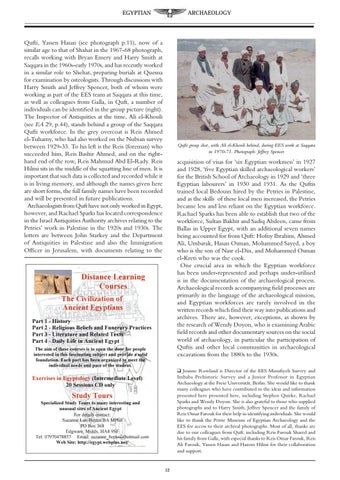
Qufti, Yassen Hasan (see photograph p.11), now of a similar age to that of Shahat in the 1967-68 photograph, recalls working with Bryan Emery and Harry Smith at Saqqara in the 1960s-early 1970s, and has recently worked in a similar role to Shehat, preparing burials at Quesna for examination by osteologists. Through discussions with Harry Smith and Jeffrey Spencer, both of whom were working as part of the EES team at Saqqara at this time, as well as colleagues from Galla, in Quft, a number of individuals can be identified in the group picture (right). The Inspector of Antiquities at the time, Ali el-Khouli (see EA 29, p.44), stands behind a group of the Saqqara Qufti workforce. In the grey overcoat is Reis Ahmed el-Tuhamy, who had also worked on the Nubian survey between 1929-33. To his left is the Reis (foreman) who succeeded him, Reis Bashir Ahmed, and on the righthand end of the row, Reis Mahmud Abd El-Rady. Reis Hilmi sits in the middle of the squatting line of men. It is important that such data is collected and recorded while it is in living memory, and although the names given here are short forms, the full family names have been recorded and will be presented in future publications. Archaeologists from Quft have not only worked in Egypt, however, and Rachael Sparks has located correspondence in the Israel Antiquities Authority archives relating to the Petries’ work in Palestine in the 1920s and 1930s. The letters are between John Starkey and the Department of Antiquities in Palestine and also the Immigration Officer in Jerusalem, with documents relating to the
Qufti group shot, with Ali el-Khouli behind, during EES work at Saqqara in 1970-71. Photograph: Jeffrey Spencer
acquisition of visas for ‘six Egyptian workmen’ in 1927 and 1928, ‘five Egyptian skilled archaeological workers’ for the British School of Archaeology in 1929 and ‘three Egyptian labourers’ in 1930 and 1931. As the Quftis trained local Bedouin hired by the Petries in Palestine, and as the skills of these local men increased, the Petries became less and less reliant on the Egyptian workforce. Rachael Sparks has been able to establish that two of the workforce, Sultan Bakhit and Sadiq Abdeen, came from Ballas in Upper Egypt, with an additional seven names being accounted for from Quft: Hofny Ibrahim, Ahmed Ali, Umbarak, Hasan Osman, Mohammed Sayed, a boy who is the son of Nasr el-Din, and Mohammed Osman el-Kreti who was the cook. One crucial area in which the Egyptian workforce has been under-represented and perhaps under-utilised is in the documentation of the archaeological process. Archaeological records accompanying field processes are primarily in the language of the archaeological mission, and Egyptian workforces are rarely involved in the written records which find their way into publications and archives. There are, however, exceptions, as shown by the research of Wendy Doyon, who is examining Arabic field records and other documentary sources on the social world of archaeology, in particular the participation of Quftis and other local communities in archaeological excavations from the 1880s to the 1930s.
Distance Learning Courses The Civilization of Ancient Egyptians Part 1 - History Part 2 - Religious Beliefs and Funerary Practices Part 3 - Literature and Related Texts Part 4 - Daily Life in Ancient Egypt The aim of these courses is to open the door for people interested in this fascinating subject and provide a solid foundation. Each part has been organized to meet the individual needs and pace of the student.
q Joanne Rowland is Director of the EES Minufiyeh Survey and Imbaba Prehistoric Survey and a Junior Professor in Egyptian Archaeology at the Freie Universität, Berlin. She would like to thank many colleagues who have contributed to the ideas and information presented here presented here, including Stephen Quirke, Rachael Sparks and Wendy Doyon. She is also grateful to those who supplied photographs and to Harry Smith, Jeffrey Spencer and the family of Reis Omar Farouk for their help in identifying individuals. She would like to thank the Petrie Museum of Egyptian Archaeology and the EES for access to their archival photographs. Most of all, thanks are due to our colleagues from Quft, including Reis Farouk Shared and his family from Galla, with especial thanks to Reis Omar Farouk, Reis Ali Farouk, Yassen Hasan and Hazem Hilmi for their collaboration and support.
Exercises in Egyptology (Intermediate Level) 20 Sessions CD only
Study Tours Specialized Study Tours to many interesting and unusual sites of Ancient Egypt For details contact: Suzanne Lax-Bojtos BA MPhil PO Box 368 Edgware, Middx. HA8 9SF Tel: 07970478857 Email: suzanne_bojtos@hotmail.com Web Site: http://egypt.webplus.net/
12