EGYPTIAN
ARCHAEOLOGY
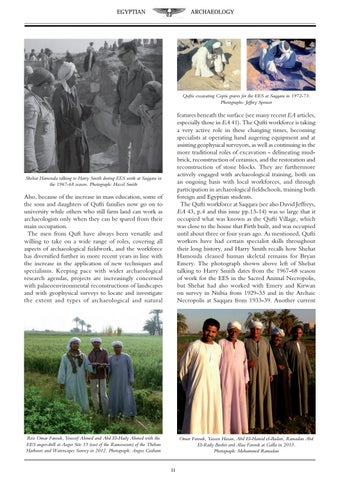
Quftis excavating Coptic graves for the EES at Saqqara in 1972-73. Photographs: Jeffrey Spencer
Also, because of the increase in mass education, some of the sons and daughters of Qufti families now go on to university while others who still farm land can work as archaeologists only when they can be spared from their main occupation. The men from Quft have always been versatile and willing to take on a wide range of roles, covering all aspects of archaeological fieldwork, and the workforce has diversified further in more recent years in line with the increase in the application of new techniques and specialisms. Keeping pace with wider archaeological research agendas, projects are increasingly concerned with palaeoenvironmental reconstructions of landscapes and with geophysical surveys to locate and investigate the extent and types of archaeological and natural
features beneath the surface (see many recent EA articles, especially those in EA 41). The Qufti workforce is taking a very active role in these changing times, becoming specialists at operating hand augering equipment and at assisting geophysical surveyors, as well as continuing in the more traditional roles of excavation - delineating mudbrick, reconstruction of ceramics, and the restoration and reconstruction of stone blocks. They are furthermore actively engaged with archaeological training, both on an ongoing basis with local workforces, and through participation in archaeological fieldschools, training both foreign and Egyptian students. The Qufti workforce at Saqqara (see also David Jeffreys, EA 43, p.4 and this issue pp.13-14) was so large that it occupied what was known as the Qufti Village, which was close to the house that Firth built, and was occupied until about three or four years ago. As mentioned, Qufti workers have had certain specialist skills throughout their long history, and Harry Smith recalls how Shehat Hamouda cleaned human skeletal remains for Bryan Emery. The photograph shown above left of Shehat talking to Harry Smith dates from the 1967-68 season of work for the EES in the Sacred Animal Necropolis, but Shehat had also worked with Emery and Kirwan on survey in Nubia from 1929-33 and in the Archaic Necropolis at Saqqara from 1933-39. Another current
Reis Omar Farouk, Youssef Ahmed and Abd El-Hady Ahmed with the EES auger-drill at Auger Site 35 (east of the Ramesseum) of the Theban Harbours and Waterscapes Survey in 2012. Photograph: Angus Graham
Omar Farouk, Yassen Hasan, Abd El-Hamid el-Badari, Ramadan Abd El-Rady Bashir and Alaa Farouk at Galla in 2013. Photograph: Mohammed Ramadan
Shehat Hamouda talking to Harry Smith during EES work at Saqqara in the 1967-68 season. Photograph: Hazel Smith
11