EGYPTIAN
ARCHAEOLOGY
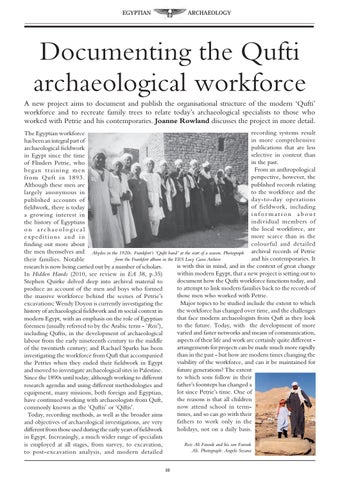
Documenting the Qufti archaeological workforce A new project aims to document and publish the organisational structure of the modern ‘Qufti’ workforce and to recreate family trees to relate today’s archaeological specialists to those who worked with Petrie and his contemporaries. Joanne Rowland discusses the project in more detail. recording systems result The Egyptian workforce in more comprehensive has been an integral part of publications that are less archaeological fieldwork selective in content than in Egypt since the time in the past. of Flinders Petrie, who From an anthropological began training men perspective, however, the from Quft in 1893. published records relating Although these men are to the workforce and the largely anonymous in day-to-day operations published accounts of of fieldwork, including fieldwork, there is today information about a growing interest in individual members of the history of Egyptians the local workforce, are on archaeological more scarce than in the expeditions and in colourful and detailed finding out more about the men themselves and Abydos in the 1920s. Frankfort’s ‘Qufti band’ at the start of a season. Photograph archival records of Petrie and his contemporaries. It from the Frankfort album in the EES Lucy Gura Archive their families. Notable is with this in mind, and in the context of great change research is now being carried out by a number of scholars. within modern Egypt, that a new project is setting out to In Hidden Hands (2010, see review in EA 38, p.35) document how the Qufti workforce functions today, and Stephen Quirke delved deep into archival material to to attempt to link modern families back to the records of produce an account of the men and boys who formed those men who worked with Petrie. the massive workforce behind the scenes of Petrie’s Major topics to be studied include the extent to which excavations; Wendy Doyon is currently investigating the the workforce has changed over time, and the challenges history of archaeological fieldwork and its social context in that face modern archaeologists from Quft as they look modern Egypt, with an emphasis on the role of Egyptian to the future. Today, with the development of more foremen (usually referred to by the Arabic term - ‘Reis’), varied and faster networks and means of communication, including Quftis, in the development of archaeological aspects of their life and work are certainly quite different labour from the early nineteenth century to the middle arrangements for projects can be made much more rapidly of the twentieth century; and Rachael Sparks has been than in the past - but how are modern times changing the investigating the workforce from Quft that accompanied viability of the workforce, and can it be maintained for the Petries when they ended their fieldwork in Egypt future generations? The extent and moved to investigate archaeological sites in Palestine. to which sons follow in their Since the 1890s until today, although working to different father’s footsteps has changed a research agendas and using different methodologies and lot since Petrie’s time. One of equipment, many missions, both foreign and Egyptian, the reasons is that all children have continued working with archaeologists from Quft, now attend school in termcommonly known as the ‘Quftis’ or ‘Qiftis’. times, and so can go with their Today, recording methods, as well as the broader aims fathers to work only in the and objectives of archaeological investigations, are very holidays, not on a daily basis. different from those used during the early years of fieldwork in Egypt. Increasingly, a much wider range of specialists Reis Ali Farouk and his son Farouk is employed at all stages, from survey, to excavation, Ali. Photograph: Angelo Sesana to post-excavation analysis, and modern detailed 10