EGYPTIAN
ARCHAEOLOGY
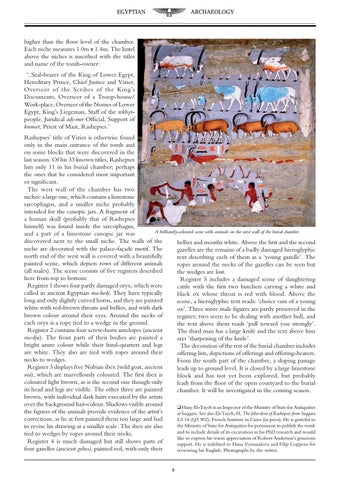
higher than the floor level of the chamber. Each niche measures 1.0m x 1.4m. The lintel above the niches is inscribed with the titles and name of the tomb-owner: ‘..Seal-bearer of the King of Lower Egypt, Hereditary Prince, Chief Justice and Vizier, Overseer of the Scribes of the King’s Documents, Overseer of a Troop-house/ Work-place, Overseer of the Nomes of Lower Egypt, King’s Liegeman, Staff of the rekhytpeople, Juridical adj-mer Official, Support of knmwt, Priest of Maat, Rashepses.’ Rashepses’ title of Vizier is otherwise found only in the main entrance of the tomb and on some blocks that were discovered in the last season. Of his 33 known titles, Rashepses lists only 11 in his burial chamber; perhaps the ones that he considered most important or significant. The west wall of the chamber has two niches: a large one, which contains a limestone sarcophagus, and a smaller niche probably intended for the canopic jars. A fragment of a human skull (probably that of Rashepses himself) was found inside the sarcophagus, A brilliantly-coloured scene with animals on the west wall of the burial chamber and a part of a limestone canopic jar was discovered next to the small niche. The walls of the bellies and mouths white. Above the first and the second niche are decorated with the palace-façade motif. The gazelles are the remains of a badly damaged hieroglyphic north end of the west wall is covered with a beautifully text describing each of them as a ‘young gazelle’. The painted scene, which depicts rows of different animals ropes around the necks of the gazelles can be seen but (all males). The scene consists of five registers described the wedges are lost. here from top to bottom: Register 5 includes a damaged scene of slaughtering Register 1 shows four partly damaged oryx, which were cattle with the first two butchers carving a white and called in ancient Egyptian ma-hedj. They have typically black ox whose throat is red with blood. Above the long and only slightly curved horns, and they are painted scene, a hieroglyphic text reads: ‘choice cuts of a young white with red-brown throats and bellies, and with dark ox’. Three more male figures are partly preserved in the brown colour around their eyes. Around the necks of register; two seem to be dealing with another bull, and each oryx is a rope tied to a wedge in the ground. the text above them reads ‘pull toward you strongly’. Register 2 contains four screw-horn antelopes (ancient The third man has a large knife and the text above him nu-dju). The front parts of their bodies are painted a says ‘sharpening of the knife’. bright azure colour while their hind-quarters and legs The decoration of the rest of the burial chamber includes are white. They also are tied with ropes around their offering lists, depictions of offerings and offering-bearers. necks to wedges. From the south part of the chamber, a sloping passage Register 3 displays five Nubian ibex (wild goat, ancient leads up to ground level. It is closed by a large limestone nia), which are marvellously coloured. The first ibex is block and has not yet been explored, but probably coloured light brown, as is the second one though only leads from the floor of the open courtyard to the burial its head and legs are visible. The other three are painted chamber. It will be investigated in the coming season. brown, with individual dark hairs executed by the artists over the background hair-colour. Shadows visible around q Hany El-Tayeb is an Inspector of the Ministry of State for Antiquities the figures of the animals provide evidence of the artist’s at Saqqara. See also El-Tayeb, H, The false-door of Rashepses from Saqqara corrections, as he at first painted them too large and had LS 16 (QS 902), French Institute in Cairo (in press). He is grateful to the Ministry of State for Antiquities for permission to publish the tomb to revise his drawing at a smaller scale. The ibex are also and to include details of its excavation in his PhD research and would tied to wedges by ropes around their necks. like to express his warm appreciation of Robert Anderson’s generous Register 4 is much damaged but still shows parts of support. He is indebted to Hana Vymazalova and Filip Coppens for four gazelles (ancient gehes), painted red, with only their reviewing his English. Photographs by the writer.