EGYPTIAN
ARCHAEOLOGY
Correction: The Winter Palace Hotel was not built in 1886 (as stated in EA 41, p.21), but opened in January 1907. Gaston Maspero in his 1901 Ruines et paysages d’Egypte notes that the channel flowing past the gardens of the Luxor Hotel (the Khor el-Ammari) had recently been in-filled and the newly reclaimed lands sold. Angus is very grateful to Sylvie Weens for the correction of the opening date of the Winter Palace and the reference to Maspero’s observations on the channel.
q Angus Graham is Field Director of THaWS and an Honorary Research Associate, Institute of Archaeology, UCL. Kristian Strutt is Assistant Director of THaWS and geophysical researcher at the University of Southampton. The fieldwork is very much a team effort and we would like to thank all those involved for their expert contributions this season. The team is grateful to all at the MSA, but especially to Mohammed Ismail in Cairo and in Luxor to Mansour Boreik, Mohammed Abd el-Aziz, Ibrahim Suleiman and our Inspectors Abeer Sayed Mohammed (Karnak) and Elazab Rageb Ahmed Abd Rabu (West Bank). We are extremely grateful to Ray Johnson, Brett McClain, Hourig Sourouzian, Rainer Stadelmann and all the ‘Memnon team’, Diana Craig Patch, Peter Lacovara, Catharine Roehrig and Joel Paulson, and Alban-Brice Pimpaud for their support of our work and to Faten Saleh, then EES Representative in Cairo. Our thanks go to our Reises, Alaa Farouk and Omar Farouk, for their expertise, logistical organisation and putting together a great team. We are very grateful to the many farmers/landowners for their generosity in allowing us to work on their land. All illustrations are by the authors © Egypt Exploration Society.
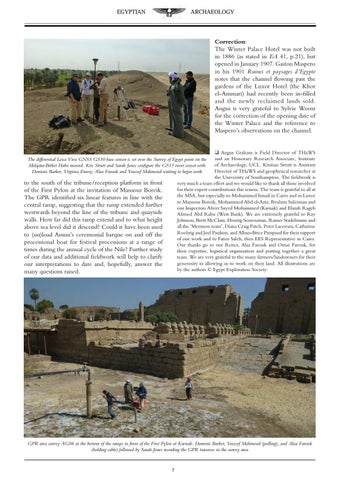
The differential Leica Viva GNSS GS10 base sensor is set over the Survey of Egypt point on the Malqata-Birket Habu mound. Kris Strutt and Sarah Jones configure the GS15 rover sensor with Dominic Barker, Virginia Emery, Alaa Farouk and Youssef Mahmoud waiting to begin work
to the south of the tribune/reception platform in front of the First Pylon at the invitation of Mansour Boreik. The GPR identified six linear features in line with the central ramp, suggesting that the ramp extended further westwards beyond the line of the tribune and quayside walls. How far did this ramp extend and to what height above sea level did it descend? Could it have been used to (un)load Amun’s ceremonial barque on and off the processional boat for festival processions at a range of times during the annual cycle of the Nile? Further study of our data and additional fieldwork will help to clarify our interpretations to date and, hopefully, answer the many questions raised.
GPR area survey AG06 at the bottom of the ramps in front of the First Pylon at Karnak. Dominic Barker, Youssef Mahmoud (pulling), and Alaa Farouk (holding cable) followed by Sarah Jones recording the GPR traverses in the survey area