EGYPTIAN
ARCHAEOLOGY
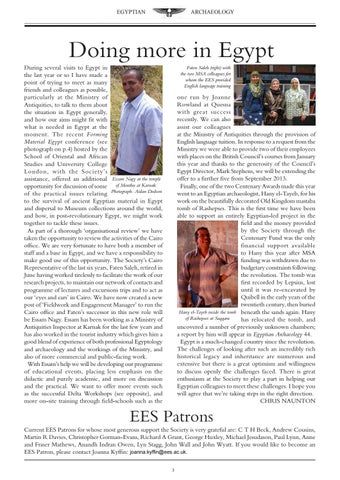
Doing more in Egypt During several visits to Egypt in the last year or so I have made a point of trying to meet as many friends and colleagues as possible, particularly at the Ministry of Antiquities, to talk to them about the situation in Egypt generally, and how our aims might fit with what is needed in Egypt at the moment. The recent Forming Material Egypt conference (see photograph on p.4) hosted by the School of Oriental and African Studies and University College London, with the Society’s assistance, offered an additional Essam Nagy at the temple opportunity for discussion of some of Monthu at Karnak. of the practical issues relating Photograph: Aidan Dodson to the survival of ancient Egyptian material in Egypt and dispersal to Museum collections around the world, and how, in post-revolutionary Egypt, we might work together to tackle these issues. As part of a thorough ‘organisational review’ we have taken the opportunity to review the activities of the Cairo office. We are very fortunate to have both a member of staff and a base in Egypt, and we have a responsibility to make good use of this opportunity. The Society’s Cairo Representative of the last six years, Faten Saleh, retired in June having worked tirelessly to facilitate the work of our research projects, to maintain our network of contacts and programme of lectures and excursions trips and to act as our ‘eyes and ears’ in Cairo. We have now created a new post of ‘Fieldwork and Engagement Manager’ to run the Cairo office and Faten’s successor in this new role will be Essam Nagy. Essam has been working as a Ministry of Antiquities Inspector at Karnak for the last few years and has also worked in the tourist industry which gives him a good blend of experience of both professional Egyptology and archaeology and the workings of the Ministry, and also of more commercial and public-facing work. With Essam’s help we will be developing our programme of educational events, placing less emphasis on the didactic and purely academic, and more on discussion and the practical. We want to offer more events such as the successful Delta Workshops (see opposite), and more on-site training through field-schools such as the
Faten Saleh (right) with the two MSA colleagues for whom the EES provided English language training
one run by Joanne Rowland at Quesna with great success recently. We can also assist our colleagues at the Ministry of Antiquities through the provision of English language tuition. In response to a request from the Ministry we were able to provide two of their employees with places on the British Council’s courses from January this year and thanks to the generosity of the Council’s Egypt Director, Mark Stephens, we will be extending the offer to a further five from September 2013. Finally, one of the two Centenary Awards made this year went to an Egyptian archaeologist, Hany el-Tayeb, for his work on the beautifully decorated Old Kingdom mastaba tomb of Rashepses. This is the first time we have been able to support an entirely Egyptian-led project in the field and the money provided by the Society through the Centenary Fund was the only financial support available to Hany this year after MSA funding was withdrawn due to budgetary constraints following the revolution. The tomb was first recorded by Lepsius, lost until it was re-excavated by Quibell in the early years of the twentieth century, then buried Hany el-Tayeb inside the tomb beneath the sands again. Hany of Rashepses at Saqqara has relocated the tomb, and uncovered a number of previously unknown chambers; a report by him will appear in Egyptian Archaeology 44. Egypt is a much-changed country since the revolution. The challenges of looking after such an incredibly rich historical legacy and inheritance are numerous and extensive but there is a great optimism and willingness to discuss openly the challenges faced. There is great enthusiasm at the Society to play a part in helping our Egyptian colleagues to meet these challenges. I hope you will agree that we’re taking steps in the right direction. CHRIS NAUNTON
EES Patrons Current EES Patrons for whose most generous support the Society is very grateful are: C T H Beck, Andrew Cousins, Martin R Davies, Christopher Gorman-Evans, Richard A Grant, George Huxley, Michael Jesudason, Paul Lynn, Anne and Fraser Mathews, Anandh Indran Owen, Lyn Stagg, John Wall and John Wyatt. If you would like to become an EES Patron, please contact Joanna Kyffin: joanna.kyffin@ees.ac.uk.