EGYPTIAN
practical guide, though at 24cm high and weighing just over a kilo, it is far from being a pocket-guide. The most substantial part is a listing (pp.88–290), geographically arranged, of 51 properties or monuments or cemeteries. Usually, basic directions are given to find each, and mostly there is a rough indication of the extent to which they can be visited or entered. Although English Heritage is the publisher, it is the National Trust that owns the lion’s share of such grand houses as are included. Egypt in England naturally concentrates upon structures that still survive: obviously not so in the case of the Crystal Palace, spectacularly destroyed by fire in 1936. The building, first sited in Hyde Park for the Great Exhibition of 1851, itself had no Egyptian characteristics, but, after its reconstruction in a modified form at Penge / Sydenham in south London, one of its main visitor-attractions from 1854 was the Egyptian Court, in which portions of a variety of well-known Egyptian monuments were reproduced with a determined aim at accuracy. The site can still be visited as the Crystal Palace Park, with a Heritage Trail, and sphinxes are among the sad survivors from the nineteenth-century features. The first half of the book contains a sequence of seven essays, each devoted to a theme or to a type of material: architecture, cemeteries, cinemas, ‘Egyptiana’, Egyptology, Freemasonry, and hieroglyphs. How interesting and useful readers may find them will necessarily vary according to their existing knowledge and interests. The reviewer can only indicate a couple of his own reactions: the essay on ‘Cinemas: the splendour of Luxor’, although the shortest, paints - together with the accounts of the Carlton Cinema (Islington) and the Pyramid (Sale, Greater Manchester), both surviving, at any rate as buildings - a vivid picture of the brief vogue for cinemas with Egyptianising exteriors or interiors and its place in the very peculiar history of cinema-buildings. ‘Egyptiana’ is Elliott’s word for ‘the more decorative aspects of the Egyptian style’ and the essay ‘Egyptiana: silver-gilt services to sewing machines’ includes interior design and furnishings; in contrast to ‘Cinemas’, it can touch on only a tiny sample of its material. For this reader, the short essay (eight pages) on ‘Egyptology’ seemed breathless, and the points might have been better made elsewhere. Elliott’s writing goes best when his enthusiasm leads him to write at greater length: for example the 38 pages about Cleopatra’s Needle, or the five pages on the restoration of the Egyptian Dining Room at Goodwood House (Chichester). Elliott disarmingly concedes (p.5) that a book deliberately planned to be used both by specialists and non-specialists ‘runs the risk of being a hybrid that satisfies no one’ though the publisher is no doubt responsible for the limitations placed upon the referencing, for which Elliott is a little apologetic (p.5). The generous colour illustrations, generally occupying a half or quarter page, are a major feature of the book, and are excellently reproduced. The captions on occasion provide information additional to that in the main text; they always give some form of picture-credit
ARCHAEOLOGY
or reference, but these are not always very informative for a reader who might wish to follow them up. This book meets well the needs of the nonspecialist cultural tourist who wishes to learn something of the background to Egyptianising buildings while an enthusiast for the legacy of ancient Egypt would need to be a great specialist indeed not to find some fresh visits to pay, or fresh issues to consider. JOHN TAIT
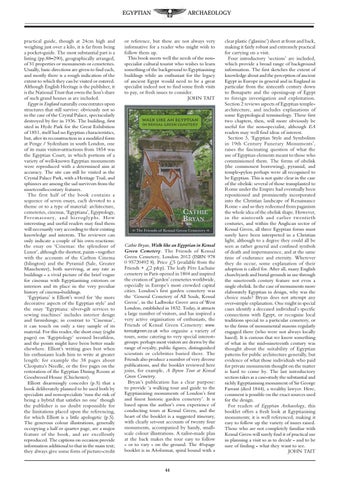
Cathie Bryan, Walk like an Egyptian in Kensal Green Cemetery. The Friends of Kensal Green Cemetery, London 2012 (ISBN 978 0 95720492 8). Price £5 (available from the Friends + £2 p&p). The leafy Père Lachaise cemetery in Paris opened in 1804 and inspired the creation of ‘garden’ cemeteries worldwide, especially in Europe’s most crowded capital cities. London’s first garden cemetery was the ‘General Cemetery of All Souls, Kensal Green’, in the Ladbroke Grove area of West London, established in 1832. Today, it attracts a large number of visitors, and has inspired a very active organisation of enthusiasts, the Friends of Kensal Green Cemetery: www. kensalgreen.co.uk who organise a variety of tours, some catering to very special interestgroups: perhaps most visitors are drawn by the range of royalty, public figures, distinguished scientists or celebrities buried there. The Friends also produce a number of very diverse publications, and the booklet reviewed here joins, for example, A Byron Tour at Kensal Green Cemetery. Bryan’s publication has a clear purpose: to provide ‘a walking tour and guide to the Egyptianizing monuments of London’s first and finest historic garden cemetery’. It is based upon the author’s own experience of conducting tours at Kensal Green, and the heart of the booklet is a suggested itinerary, with clearly set-out accounts of twenty four monuments, accompanied by handy, smallscale colour illustrations. A tailor-made plan at the back makes the tour easy to follow - or to vary - on the ground. The 40-page booklet is in A4-format, spiral bound with a
44
clear plastic (‘glassine’) sheet at front and back, making it fairly robust and extremely practical for carrying on a visit. Four introductory ‘sections’ are included, which provide a broad range of background information. The first sketches the extent of knowledge about and the perception of ancient Egypt in Europe in general and in England in particular from the sixteenth century down to Bonaparte and the opening-up of Egypt to foreign investigation and exploitation. Section 2 reviews aspects of Egyptian templearchitecture, and includes explanations of some Egyptological terminology. These first two chapters, then, will more obviously be useful for the non-specialist, although EA readers may well find ideas of interest. Section 3, ‘Egyptian Style and Symbolism in 19th Century Funerary Monuments’, raises the fascinating question of what the use of Egyptian elements meant to those who commissioned them. The forms of obelisk (the commonest borrowing), pyramid, and temple-pylon perhaps were all recognised to be Egyptian. This is not quite clear in the case of the obelisk: several of those transplanted to Rome under the Empire had eventually been repositioned and prominently incorporated into the Christian landscape of Renaissance Rome - and so they redeemed from paganism the whole idea of the obelisk shape. However, in the ninteenth and earlier twentieth centuries, and within the Anglican sector of Kensal Green, all three Egyptian forms must surely have been interpreted in a Christian light, although to a degree they could all be seen as rather general and confused symbols of death and impermanence, and at the same time of endurance and eternity. Wherever they do occur, some explanation of their adoption is called for. After all, many English churchyards and burial grounds in use through the nineteenth century feature not even a single obelisk. In the case of monuments more elaborately Egyptian in design, why was the choice made? Bryan does not attempt any over-simple explanation. One might in special cases identify a deceased individual’s specific connections with Egypt, or recognise local traditions special to a particular cemetery, or to the firms of monumental masons regularly engaged there (who were not always locally based). It is curious that we know something of what in the mid-nineteenth century was thought about the suitability of Egyptian patterns for public architecture generally, but evidence of what those individuals who paid for private monuments thought on the matter is hard to come by. The last introductory section takes as a case-study the substantial and richly Egyptianising monument of Sir George Farrant (died 1844), a wealthy lawyer. Here, comment is possible on the exact sources used for the design. For readers of Egyptian Archaeology, this booklet offers a fresh look at Egyptianising monuments; it is well referenced, making it easy to follow up the variety of issues raised. Those who are not completely familiar with Kensal Green will surely find it of practical use in planning a visit so as to decide - and to be sure of finding - what they want to see. JOHN TAIT