EGYPTIAN
ARCHAEOLOGY
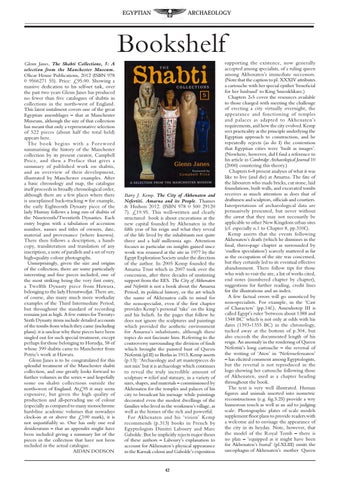
Bookshelf Glenn Janes, The Shabti Collections, 5: A selection from the Manchester Museum. Olicar House Publications, 2012 (ISBN 978 0 9566271 55). Price: £95.00. Showing a massive dedication to his self-set task, over the past two years Glenn Janes has produced no fewer than five catalogues of shabtis in collections in the north-west of England. This latest instalment covers one of the great Egyptian assemblages – that at Manchester Museum, although the size of that collection has meant that only a representative selection of 522 pieces (about half the total held) appears here. The book begins with a Foreword summarising the history of the Manchester collection by its present curator, Campbell Price, and then a Preface that gives a summary of published work on shabtis, and an overview of their development, illustrated by Manchester examples. After a basic chronology and map, the catalogue itself proceeds in broadly chronological order, although there are a few places where there is unexplained back-tracking – for example, the early Eighteenth Dynasty piece of the lady Humay follows a long run of shabtis of the Nineteenth/Twentieth Dynasties. Each entry begins with a tabulation of accession number, names and titles of owners, date, material and provenance (where known). There then follows a description, a handcopy, transliteration and translation of any inscription, a note of parallels and a set of very high-quality colour photographs. Unsurprisingly, given the size and origins of the collection, there are some particularly interesting and fine pieces included, one of the most striking being the very first entry, a Twelfth Dynasty piece from Hawara, belonging to the lady Henutwedjat. There are, of course, also many much more workaday examples of the Third Intermediate Period, but throughout the standard of recording remains just as high. A few entries for TwentySixth Dynasty items include detailed accounts of the tombs from which they came (including plans): it is unclear why these pieces have been singled out for such special treatment, except perhaps for those belonging to Horudja, 58 of whose 399 shabtis came to Manchester from Petrie’s work at Hawara. Glenn Janes is to be congratulated for this splendid treatment of the Manchester shabti collection, and one greatly looks forward to further volumes in the series – and hopefully some on shabti collections outside the north-west of England. At£95 it may seem expensive, but given the high quality of production and all-pervading use of colour (especially as compared to many monochrome hard-line academic volumes that nowadays clock-in at or above the £100 mark), it is not unjustifiably so. One has only one real desideratum – that an appendix might have been included giving a summary list of the pieces in the collection that have not been included in the actual catalogue. AIDAN DODSON
Barry J. Kemp. The City of Akhenaten and Nefertiti. Amarna and its People. Thames & Hudson 2012. (ISBN 978 0 500 29120 7). £19.95. This well-written and clearly structured book is about excavations at the new capital founded by Akhenaten in the fifth year of his reign and what they reveal of the life lived by the inhabitants not quite three and a half millennia ago. Attention focuses in particular on insights gained since work was resumed at the site in 1977 by the Egypt Exploration Society under the direction of the author. In 2005 Kemp founded the Amarna Trust which in 2007 took over the concession, after three decades of unstinting support from the EES. The City of Akhenaten and Nefertiti is not a book about the Amarna Period, its political history, or the art which the name of Akhenaten calls to mind for the non-specialist, even if the first chapter provides Kemp’s personal ‘take’ on the king and his beliefs. In the pages that follow he does not ignore the sculptures and paintings which provided the aesthetic environment for Amarna’s inhabitants, although these topics do not fascinate him. Referring to the controversy surrounding the division of finds which brought the painted bust of Queen Nefertiti (pl.II) to Berlin in 1913, Kemp asserts (p.13): ‘Archaeology and art masterpieces do not mix’ but it is archaeology which continues to reveal the truly incredible amount of sculpture – relief and statuary, in a variety of sizes, shapes, and materials – commissioned by Akhenaten for the temples and palaces of his city to broadcast his message while paintings decorated even the modest dwellings of the families who lived in the workmen’s village, as well as the homes of the rich and powerful. For Akhenaten and his ‘vision’ Kemp recommends (p.313) books in French by Egyptologists Dimitri Laboury and Marc Gabolde. But he implicitly rejects major theses of these authors – Laboury’s explanation to account for Akhenaten’s physical appearance in the Karnak colossi and Gabolde’s exposition 42
supporting the existence, now generally accepted among specialists, of a ruling queen among Akhenaten’s immediate successors. (Note that the caption to pl. XXXIV attributes a cartouche with her special epithet ‘beneficial for her husband’ to King Smenkhkare.) Chapters 2-5 cover the resources available to those charged with meeting the challenge of erecting a city virtually overnight, the appearance and functioning of temples and palaces as adapted to Akhenaten’s requirements, and how the city evolved. Kemp sees practicality as the principle underlying the Egyptian approach to construction, and he repeatedly rejects (as do I) the contention that Egyptian cities were ‘built as images’. (Nowhere, however, did I find a reference to his article in Cambridge Archaeological Journal 10 (2000) countering this theory.) Chapters 6-8 present analyses of what it was like to live (and die) at Amarna. The fate of the labourers who made bricks, cut stone, laid foundations, built walls, and excavated tombs receives as much attention as does that of draftsmen and sculptors, officials and courtiers. Interpretations of archaeological data are persuasively presented, but never without the caveat that they may not necessarily be applicable to other New Kingdom urban sites (cf. especially n.1 to Chapter 8, pp.310f.). Kemp asserts that the events following Akhenaten’s death (which he dismisses in the final, three-page chapter as surrounded by ‘endless speculation’) scarcely mattered as far as the occupation of the site was concerned, but they certainly led to its eventual effective abandonment. There follow tips for those who wish to visit the site, a list of works cited, end notes (numbered chapter by chapter), suggestions for further reading, credit lines for the illustrations and an index. A few factual errors will go unnoticed by non-specialists. For example, in the ‘Cast of Characters’ (pp.14f.), Amenhotep III is called Egypt’s ruler ‘between about 1388 and 1348 BC’ which is not only at odds with his dates (1393-1355 BC) in the chronology, tucked away at the bottom of p.304, but also exceeds the documented length of his reign. An anomaly in the rendering of Queen Nefertiti’s long cartouche – the reversal of the writing of ‘Aten’ in ‘Neferneferuaten’ – has elicited comment among Egyptologists, but the reversal is not reproduced in the logo showing her cartouche following those of Akhenaten, used as a chapter heading throughout the book. The text is very well illustrated. Human figures and animals inserted into isometric reconstructions (e.g. fig.5.25) provide a wry humorous touch as well as an aid to judging scale. Photographic plates of scale models supplement floor plans to provide readers with a welcome aid to envisage the appearance of the city in its heyday. Note, however, that the model of the Royal Tomb – there is no plan – ‘equipped as it might have been for Akhenaten’s burial’ (pl.XLIII) omits the sarcophagus of Akhenaten’s mother Queen