EGYPTIAN
ARCHAEOLOGY
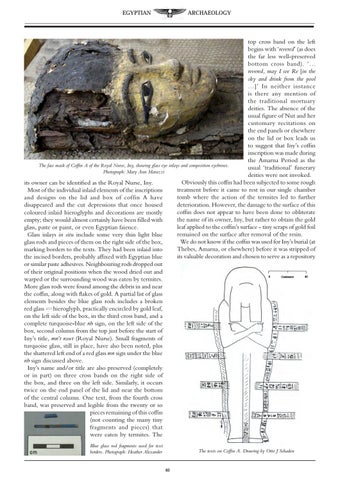
top cross band on the left begins with ‘revered’ (as does the far less well-preserved bottom cross band). ‘... revered, may I see Re [in the sky and drink from the pool …]’ In neither instance is there any mention of the traditional mortuary deities. The absence of the usual figure of Nut and her customary recitations on the end panels or elsewhere on the lid or box leads us to suggest that Iny’s coffin inscription was made during the Amarna Period as the The face mask of Coffin A of the Royal Nurse, Iny, showing glass eye inlays and composition eyebrows. usual ‘traditional’ funerary Photograph: Mary Ann Marazzi deities were not invoked. Obviously this coffin had been subjected to some rough its owner can be identified as the Royal Nurse, Iny. treatment before it came to rest in our single chamber Most of the individual inlaid elements of the inscriptions tomb where the action of the termites led to further and designs on the lid and box of coffin A have deterioration. However, the damage to the surface of this disappeared and the cut depressions that once housed coffin does not appear to have been done to obliterate coloured inlaid hieroglyphs and decorations are mostly the name of its owner, Iny, but rather to obtain the gold empty; they would almost certainly have been filled with leaf applied to the coffin’s surface - tiny scraps of gold foil glass, paste or paint, or even Egyptian faience. remained on the surface after removal of the resin. Glass inlays in situ include some very thin light blue We do not know if the coffin was used for Iny’s burial (at glass rods and pieces of them on the right side of the box, Thebes, Amarna, or elsewhere) before it was stripped of marking borders to the texts. They had been inlaid into its valuable decoration and chosen to serve as a repository the incised borders, probably affixed with Egyptian blue or similar paste adhesives. Neighbouring rods dropped out of their original positions when the wood dried out and warped or the surrounding wood was eaten by termites. More glass rods were found among the debris in and near the coffin, along with flakes of gold. A partial list of glass elements besides the blue glass rods includes a broken red glass ›hieroglyph, practically encircled by gold leaf, on the left side of the box, in the third cross band, and a complete turquoise-blue nb sign, on the left side of the box, second column from the top just before the start of Iny’s title, mnat nzwt (Royal Nurse). Small fragments of turquoise glass, still in place, have also been noted, plus the shattered left end of a red glass mn sign under the blue nb sign discussed above. Iny’s name and/or title are also preserved (completely or in part) on three cross bands on the right side of the box, and three on the left side. Similarly, it occurs twice on the end panel of the lid and near the bottom of the central column. One text, from the fourth cross band, was preserved and legible from the twenty or so pieces remaining of this coffin (not counting the many tiny fragments and pieces) that were eaten by termites. The Blue glass rod fragments used for text borders. Photograph: Heather Alexander
The texts on Coffin A. Drawing by Otto J Schaden 40