EGYPTIAN
ARCHAEOLOGY
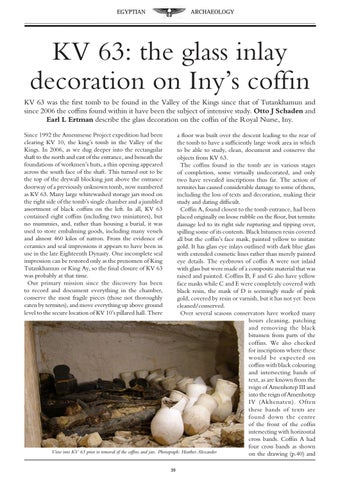
KV 63: the glass inlay decoration on Iny’s coffin KV 63 was the first tomb to be found in the Valley of the Kings since that of Tutankhamun and since 2006 the coffins found within it have been the subject of intensive study. Otto J Schaden and Earl L Ertman describe the glass decoration on the coffin of the Royal Nurse, Iny. Since 1992 the Amenmesse Project expedition had been clearing KV 10, the king’s tomb in the Valley of the Kings. In 2006, as we dug deeper into the rectangular shaft to the north and east of the entrance, and beneath the foundations of workmen’s huts, a thin opening appeared across the south face of the shaft. This turned out to be the top of the drywall blocking just above the entrance doorway of a previously unknown tomb, now numbered as KV 63. Many large whitewashed storage jars stood on the right side of the tomb’s single chamber and a jumbled assortment of black coffins on the left. In all, KV 63 contained eight coffins (including two miniatures), but no mummies, and, rather than housing a burial, it was used to store embalming goods, including many vessels and almost 460 kilos of natron. From the evidence of ceramics and seal impressions it appears to have been in use in the late Eighteenth Dynasty. One incomplete seal impression can be restored only as the prenomen of King Tutankhamun or King Ay, so the final closure of KV 63 was probably at that time. Our primary mission since the discovery has been to record and document everything in the chamber, conserve the most fragile pieces (those not thoroughly eaten by termites), and move everything up above ground level to the secure location of KV 10’s pillared hall. There
a floor was built over the descent leading to the rear of the tomb to have a sufficiently large work area in which to be able to study, clean, document and conserve the objects from KV 63. The coffins found in the tomb are in various stages of completion, some virtually undecorated, and only two have revealed inscriptions thus far. The action of termites has caused considerable damage to some of them, including the loss of texts and decoration, making their study and dating difficult. Coffin A, found closest to the tomb entrance, had been placed originally on loose rubble on the floor, but termite damage led to its right side rupturing and tipping over, spilling some of its contents. Black bitumen resin covered all but the coffin’s face mask, painted yellow to imitate gold. It has glass eye inlays outlined with dark blue glass with extended cosmetic lines rather than merely painted eye details. The eyebrows of coffin A were not inlaid with glass but were made of a composite material that was raised and painted. Coffins B, F and G also have yellow face masks while C and E were completely covered with black resin, the mask of D is seemingly made of pink gold, covered by resin or varnish, but it has not yet been cleaned/conserved. Over several seasons conservators have worked many hours cleaning, patching and removing the black bitumen from parts of the coffins. We also checked for inscriptions where these would be expected on coffins with black colouring and intersecting bands of text, as are known from the reign of Amenhotep III and into the reign of Amenhotep IV (Akhenaten). Often these bands of texts are found down the centre of the front of the coffin intersecting with horizontal cross bands. Coffin A had four cross bands as shown View into KV 63 prior to removal of the coffins and jars. Photograph: Heather Alexander on the drawing (p.40) and 39