EGYPTIAN
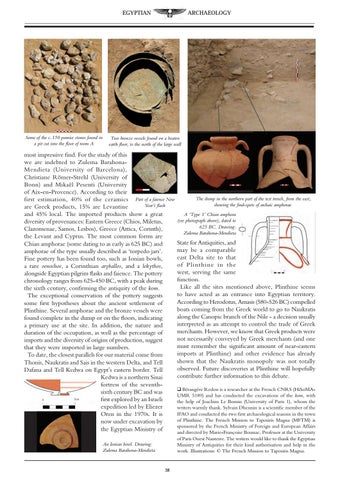
Some of the c.150 pumice stones found in a pit cut into the floor of room A
ARCHAEOLOGY
Two bronze vessels found on a beaten earth floor, to the north of the large wall
most impressive find. For the study of this we are indebted to Zulema BarahonaMendieta (University of Barcelona), Christiane Römer-Strehl (University of Bonn) and Mikaël Pesenti (University of Aix-en-Provence). According to their first estimation, 40% of the ceramics Part of a faience New Year’s flask are Greek products, 15% are Levantine and 45% local. The imported products show a great diversity of provenances: Eastern Greece (Chios, Miletus, Clazomenae, Samos, Lesbos), Greece (Attica, Corinth), the Levant and Cyprus. The most common forms are Chian amphorae (some dating to as early as 625 BC) and amphorae of the type usually described as ‘torpedo jars’. Fine pottery has been found too, such as Ionian bowls, a rare oenochoe, a Corinthian aryballos, and a lekythos, alongside Egyptian pilgrim flasks and faience. The pottery chronology ranges from 625-450 BC, with a peak during the sixth century, confirming the antiquity of the kom. The exceptional conservation of the pottery suggests some first hypotheses about the ancient settlement of Plinthine. Several amphorae and the bronze vessels were found complete in the dump or on the floors, indicating a primary use at the site. In addition, the nature and duration of the occupation, as well as the percentage of imports and the diversity of origins of production, suggest that they were imported in large numbers. To date, the closest parallels for our material come from Thonis, Naukratis and Sais in the western Delta, and Tell Dafana and Tell Kedwa on Egypt’s eastern border. Tell Kedwa is a northern Sinai fortress of the seventhsixth century BC and was first explored by an Israeli expedition led by Eliezer Oren in the 1970s. It is now under excavation by the Egyptian Ministry of An Ionian bowl. Drawing: Zulema Barahona-Mendieta
38
The dump in the northern part of the test trench, from the east, showing the find-spots of archaic amphorae A ‘Type 1’ Chian amphora (see photograph above), dated to 625 BC. Drawing: Zulema Barahona-Mendieta
State for Antiquities, and may be a comparable east Delta site to that of Plinthine in the west, serving the same function. Like all the sites mentioned above, Plinthine seems to have acted as an entrance into Egyptian territory. According to Herodotus, Amasis (580-526 BC) compelled boats coming from the Greek world to go to Naukratis along the Canopic branch of the Nile - a decision usually interpreted as an attempt to control the trade of Greek merchants. However, we know that Greek products were not necessarily conveyed by Greek merchants (and one must remember the significant amount of near-eastern imports at Plinthine) and other evidence has already shown that the Naukratis monopoly was not totally observed. Future discoveries at Plinthine will hopefully contribute further information to this debate. q Bérangère Redon is a researcher at the French CNRS (HiSoMAUMR 5189) and has conducted the excavations of the kom, with the help of Joachim Le Bomin (University of Paris 1), whom the writers warmly thank. Sylvain Dhennin is a scientific member of the IFAO and conducted the two first archaeological seasons in the town of Plinthine. The French Mission to Taposiris Magna (MFTM) is sponsored by the French Ministry of Foreign and European Affairs and directed by Marie-Françoise Boussac, Professor at the University of Paris Ouest Nanterre. The writers would like to thank the Egyptian Ministry of Antiquities for their kind authorisation and help in the work. Illustrations: © The French Mission to Taposiris Magna.