EGYPTIAN
ARCHAEOLOGY
The identification of Kom el-Nugus as Plinthine Of the two sites being studied by the French expedition, Taposiris Magna is the better known while Kom el-Nugus had long been neglected and its identification as ancient Plinthine sometimes questioned in the absence of written proof. The only previous fieldwork at the site, mainly in the necropolis, was by Achille Adriani in 1937, followed by the Egyptian Antiquities Organisation in the 1960s. In his publication, Adriani emphasized the limited duration of the settlement (mainly Hellenistic), and questioned, as had others, the chronology and function of the artificial kom overlooking the city: could it have been a fortress, an agora, a theatre or an amphitheatre? Ascertaining the duration of the settlement and explaining its decline was considered a priority by our expedition, which has concluded that the city might have suffered, probably as early as the late Hellenistic Period, from the development of Taposiris Magna as an alternative gateway into Egypt. Our fieldwork initially focused on the necropolis, west of the urban settlement, confirming the city’s short life span (from the late fourth/early third century BC until the late Hellenistic/early Roman Period) and providing evidence for signs of abandonment from the second century BC onwards. A survey of the ceramics and topographical and architectural mapping conducted under the direction of Thibaud Fournet in the urban areas since 2000 has highlighted the scale of an imposing city whose lower parts have been destroyed by modern construction and the development of fishponds in the lake. The surveys have also shown the density of urban occupation west of a wadi cutting the city in two from north to south on the axis of the man-made kom, and probably corresponding to a main axis through the city. This seems to confirm that the golden age of the lower town was during the Hellenistic Period, with a clear preponderance of ceramics of the second century BC. The discovery of a fragment of a Chian calyx of the sixth century BC during the survey led us to assume that an older occupation could have taken place at Plinthine, as suggested by Hellanicus (Fr. 155, apud Athenaeus, saying that wine was invented there) and Herodotus (who mentions, in his Histories II, 6, the gulf of Plinthine). The 2013 campaign of excavation on the kom has probably shown that our assumption was right. MARIE-FRANÇOISE BOUSSAC
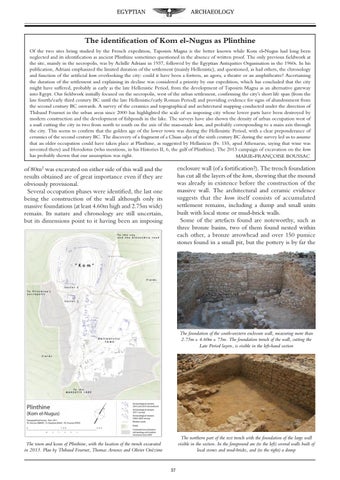
enclosure wall (of a fortification?). The trench foundation has cut all the layers of the kom, showing that the mound was already in existence before the construction of the massive wall. The architectural and ceramic evidence suggests that the kom itself consists of accumulated settlement remains, including a dump and small units built with local stone or mud-brick walls. Some of the artefacts found are noteworthy, such as three bronze basins, two of them found nested within each other, a bronze arrowhead and over 150 pumice stones found in a small pit, but the pottery is by far the
of 80m2 was excavated on either side of this wall and the results obtained are of great importance even if they are obviously provisional. Several occupation phases were identified, the last one being the construction of the wall although only its massive foundations (at least 4.60m high and 2.75m wide) remain. Its nature and chronology are still uncertain, but its dimensions point to it having been an imposing
The foundation of the south-western enclosure wall, measuring more than 2.75m x 4.60m x 75m. The foundation trench of the wall, cutting the Late Period layers, is visible in the left-hand section
The northern part of the test trench with the foundation of the large wall visible in the section. In the foreground are (to the left) several walls built of local stones and mud-bricks, and (to the right) a dump
The town and kom of Plinthine, with the location of the trench excavated in 2013. Plan by Thibaud Fournet, Thomas Arnoux and Olivier Onézime
37