EGYPTIAN
ARCHAEOLOGY
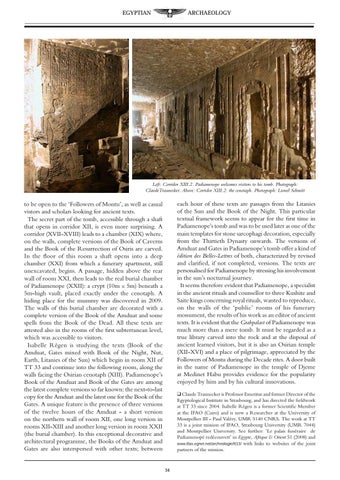
Left: Corridor XIII.2. Padiamenope welcomes visitors to his tomb. Photograph: ClaudeTraunecker. Above: Corridor XIII.2: the cenotaph. Photograph: Lionel Schmitt
each hour of these texts are passages from the Litanies of the Sun and the Book of the Night. This particular textual framework seems to appear for the first time in Padiamenope’s tomb and was to be used later as one of the main templates for stone sarcophagi decoration, especially from the Thirtieth Dynasty onwards. The versions of Amduat and Gates in Padiamenope’s tomb offer a kind of édition des Belles-Lettres of both, characterized by revised and clarified, if not completed, versions. The texts are personalised for Padiamenope by stressing his involvement in the sun’s nocturnal journey. It seems therefore evident that Padiamenope, a specialist in the ancient rituals and counsellor to three Kushite and Saite kings concerning royal rituals, wanted to reproduce, on the walls of the ‘public’ rooms of his funerary monument, the results of his work as an editor of ancient texts. It is evident that the Grabpalast of Padiamenope was much more than a mere tomb. It must be regarded as a true library carved into the rock and at the disposal of ancient learned visitors, but it is also an Osirian temple (XII-XVI) and a place of pilgrimage, appreciated by the Followers of Montu during the Decade rites. A door built in the name of Padiamenope in the temple of Djeme at Medinet Habu provides evidence for the popularity enjoyed by him and by his cultural innovations.
to be open to the ‘Followers of Montu’, as well as casual vistors and scholars looking for ancient texts. The secret part of the tomb, accessible through a shaft that opens in corridor XII, is even more surprising. A corridor (XVII-XVIII) leads to a chamber (XIX) where, on the walls, complete versions of the Book of Caverns and the Book of the Resurrection of Osiris are carved. In the floor of this room a shaft opens into a deep chamber (XXI) from which a funerary apartment, still unexcavated, begins. A passage, hidden above the rear wall of room XXI, then leads to the real burial chamber of Padiamenope (XXII): a crypt (10m x 5m) beneath a 5m-high vault, placed exactly under the cenotaph. A hiding place for the mummy was discovered in 2009. The walls of this burial chamber are decorated with a complete version of the Book of the Amduat and some spells from the Book of the Dead. All these texts are attested also in the rooms of the first subterranean level, which was accessible to visitors. Isabelle Régen is studying the texts (Book of the Amduat, Gates mixed with Book of the Night, Nut, Earth, Litanies of the Sun) which begin in room XII of TT 33 and continue into the following room, along the walls facing the Osirian cenotaph (XIII). Padiamenope’s Book of the Amduat and Book of the Gates are among the latest complete versions so far known: the next-to-last copy for the Amduat and the latest one for the Book of the Gates. A unique feature is the presence of three versions of the twelve hours of the Amduat - a short version on the northern wall of room XII, one long version in rooms XII-XIII and another long version in room XXII (the burial chamber). In this exceptional decorative and architectural programme, the Books of the Amduat and Gates are also interspersed with other texts; between
q Claude Traunecker is Professor Emeritus and former Director of the Egyptological Institute in Strasbourg, and has directed the fieldwork at TT 33 since 2004. Isabelle Régen is a former Scientific Member at the IFAO (Cairo) and is now a Researcher at the University of Montpellier III - Paul Valéry, UMR 5140 CNRS. The work at TT 33 is a joint mission of IFAO, Strasbourg University (UMR 7044) and Montpellier University. See further: ‘Le palais funéraire de Padiamenopé redécouvert’ in Egypte, Afrique & Orient 51 (2008) and www.ifao.egnet.net/archeologie/tt33/ with links to websites of the joint partners of the mission.
34