EGYPTIAN
ARCHAEOLOGY
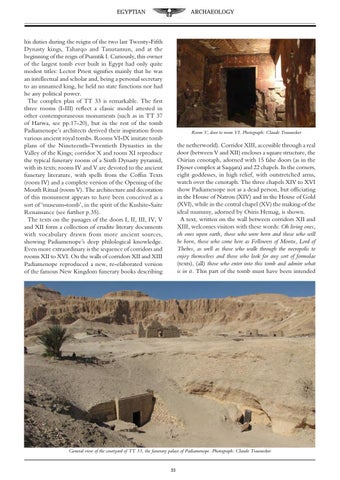
his duties during the reigns of the two last Twenty-Fifth Dynasty kings, Taharqo and Tanutamun, and at the beginning of the reign of Psamtik I. Curiously, this owner of the largest tomb ever built in Egypt had only quite modest titles: Lector Priest signifies mainly that he was an intellectual and scholar and, being a personal secretary to an unnamed king, he held no state functions nor had he any political power. The complex plan of TT 33 is remarkable. The first three rooms (I-III) reflect a classic model attested in other contemporaneous monuments (such as in TT 37 of Harwa, see pp.17-20), but in the rest of the tomb Padiamenope’s architects derived their inspiration from various ancient royal tombs. Rooms VI-IX imitate tomb plans of the Nineteenth-Twentieth Dynasties in the Valley of the Kings; corridor X and room XI reproduce the typical funerary rooms of a Sixth Dynasty pyramid, with its texts; rooms IV and V are devoted to the ancient funerary literature, with spells from the Coffin Texts (room IV) and a complete version of the Opening of the Mouth Ritual (room V). The architecture and decoration of this monument appears to have been conceived as a sort of ‘museum-tomb’, in the spirit of the Kushite-Saite Renaissance (see further p.35). The texts on the passages of the doors I, II, III, IV, V and XII form a collection of erudite literary documents with vocabulary drawn from more ancient sources, showing Padiamenope’s deep philological knowledge. Even more extraordinary is the sequence of corridors and rooms XII to XVI. On the walls of corridors XII and XIII Padiamenope reproduced a new, re-elaborated version of the famous New Kingdom funerary books describing
Room V, door to room VI. Photograph: Claude Traunecker
the netherworld). Corridor XIII, accessible through a real door (between V and XII) encloses a square structure, the Osirian cenotaph, adorned with 15 false doors (as in the Djoser complex at Saqqara) and 22 chapels. In the corners, eight goddesses, in high relief, with outstretched arms, watch over the cenotaph. The three chapels XIV to XVI show Padiamenope not as a dead person, but officiating in the House of Natron (XIV) and in the House of Gold (XVI), while in the central chapel (XV) the making of the ideal mummy, adorned by Osiris Hemag, is shown. A text, written on the wall between corridors XII and XIII, welcomes visitors with these words: Oh living ones, oh ones upon earth, those who were born and those who will be born, those who come here as Followers of Montu, Lord of Thebes, as well as those who walk through the necropolis to enjoy themselves and those who look for any sort of formulae (texts), (all) those who enter into this tomb and admire what is in it. This part of the tomb must have been intended
General view of the courtyard of TT 33, the funerary palace of Padiamenope. Photograph: Claude Traunecker 33