EGYPTIAN
ARCHAEOLOGY
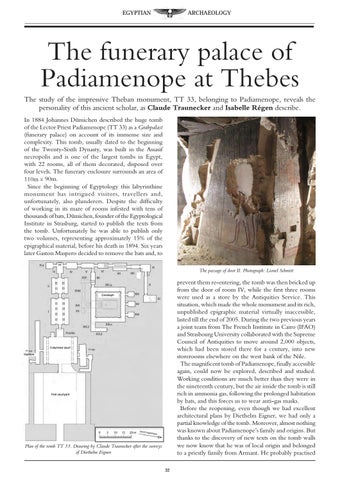
The funerary palace of Padiamenope at Thebes The study of the impressive Theban monument, TT 33, belonging to Padiamenope, reveals the personality of this ancient scholar, as Claude Traunecker and Isabelle Régen describe. In 1884 Johannes Dümichen described the huge tomb of the Lector Priest Padiamenope (TT 33) as a Grabpalast (funerary palace) on account of its immense size and complexity. This tomb, usually dated to the beginning of the Twenty-Sixth Dynasty, was built in the Assasif necropolis and is one of the largest tombs in Egypt, with 22 rooms, all of them decorated, disposed over four levels. The funerary enclosure surrounds an area of 110m x 90m. Since the beginning of Egyptology this labyrinthine monument has intrigued visitors, travellers and, unfortunately, also plunderers. Despite the difficulty of working in its maze of rooms infested with tens of thousands of bats, Dümichen, founder of the Egyptological Institute in Strasburg, started to publish the texts from the tomb. Unfortunately he was able to publish only two volumes, representing approximately 15% of the epigraphical material, before his death in 1894. Six years later Gaston Maspero decided to remove the bats and, to The passage of door II. Photograph: Lionel Schmitt
prevent them re-entering, the tomb was then bricked up from the door of room IV, while the first three rooms were used as a store by the Antiquities Service. This situation, which made the whole monument and its rich, unpublished epigraphic material virtually inaccessible, lasted till the end of 2005. During the two previous years a joint team from The French Institute in Cairo (IFAO) and Strasbourg University collaborated with the Supreme Council of Antiquities to move around 2,000 objects, which had been stored there for a century, into new storerooms elsewhere on the west bank of the Nile. The magnificent tomb of Padiamenope, finally accessible again, could now be explored, described and studied. Working conditions are much better than they were in the nineteenth century, but the air inside the tomb is still rich in ammonia gas, following the prolonged habitation by bats, and this forces us to wear anti-gas masks. Before the reopening, even though we had excellent architectural plans by Diethelm Eigner, we had only a partial knowledge of the tomb. Moreover, almost nothing was known about Padiamenope’s family and origins. But thanks to the discovery of new texts on the tomb walls we now know that he was of local origin and belonged to a priestly family from Armant. He probably practised
Cenotaph
Columned court Wahibre
First courtyard
Plan of the tomb TT 33. Drawing by Claude Traunecker after the surveys of Diethelm Eigner 32