EGYPTIAN
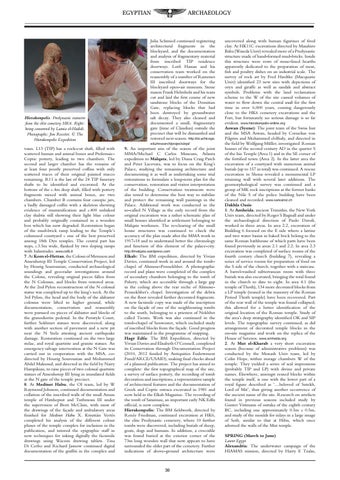
Hierakonpolis. Predynastic statuette from the elite cemetery HK6. Right: being conserved by Lamia el-Hadidi. Photographs: Jim Rossiter. © The Hierakonpolis Expedition vases. L13 (TIP) has a rock-cut shaft, filled with scattered human and animal bones and PtolemaicCoptic pottery, leading to two chambers. The second and larger chamber has the remains of at least four poorly preserved coffins with only scattered traces of their original painted stucco remaining. R11 is the last of the 24 TIP funerary shafts to be identified and excavated. At the bottom of the c.4m deep shaft, filled with pottery fragments mixed with animal bones, are two chambers. Chamber B contains four canopic jars, a badly damaged coffin with a skeleton showing evidence of mummification and c.400 unbaked clay shabtis still showing their light blue colour and probably originally contained in a wooden box which has now degraded. Restoration began of the mud-brick ramp leading to the Temple’s columned courtyard - one of the best preserved among 18th Dyn temples. The central part has steps, c.3.5m wide, flanked by two sloping ramps with balustrades. www.cefb.it 7. At Kom el-Hettan, the Colossi of Memnon and Amenhotep III Temple Conservation Project, led by Hourig Sourouzian, conducted archaeological soundings and geo-radar investigations around the Colossi, revealing original pieces fallen from the N Colossus, and blocks from restored areas. At the 2nd Pylon reconstruction of the N colossal statue was completed up to the king’s neck. At the 3rd Pylon, the head and the body of the alabaster colossus were lifted to higher ground, while documentation, conservation and reassembly were pursued on pieces of alabaster and blocks of the granodiorite pedestal. In the Peristyle Court, further Sekhmet statues were discovered, along with another section of pavement and a new pit near the N Stela attesting ancient earthquake damage. Restoration continued on the two large stelae, and royal quartzite and granite statues. An emergency salvage intervention at the N Gate was carried out in cooperation with the MSA, codirected by Hourig Sourouzian and Mohammed Abdel Maksoud, and directed in the field by Nairy Hampikian, to raise pieces of two colossal quartzite statues of Amenhotep III lying in inundated fields at the N gate of the temple precinct. 8. At Medinet Habu, the OI team, led by W Raymond Johnson, continued documentation and collation of the inscribed walls of the small Amun temple of Hatshepsut and Tuthmosis III under the supervision of Brett McClain, with most of the drawings of the façade and ambulatory areas finished for Medinet Habu X. Krisztián Vertés completed his analysis of the different colour phases of the temple complex for inclusion in the publication, and tutored the epigraphic staff in new techniques for inking digitally the facsimile drawings using Wacom drawing tablets. Tina Di Cerbo and Richard Jasnow continued digital documentation of the graffiti in the complex and
ARCHAEOLOGY
Julia Schmied continued registering architectural fragments in the blockyard, and the documentation and analysis of fragmentary material from inscribed TIP residence doorways. Lotfi Hassan and his conservation team worked on the reassembly of a number of Ramesses III inscribed doorways for the blockyard open-air museum. Stone mason Frank Helmholz and his team cut and laid the first course of new sandstone blocks of the Domitian Gate, replacing blocks that had been destroyed by groundwater salt decay. They also cleaned and documented a small, fragmentary gate (time of Claudius) outside the precinct that will be dismantled and restored next season. http://oi.uchicago. edu/research/projects/epi/
9. An important aim of the season of the joint MMA/Michael C Carlos Museum, Atlanta expedition to Malqata, led by Diana Craig Patch and Peter Lacovara, was to focus on the King’s Palace, studying the remaining architecture and documenting it as well as undertaking some trial restorations to formulate a long-term plan for the conservation, restoration and visitor interpretation of the building. Conservation treatments were also tested to determine the best way to stabilise and protect the remaining wall paintings in the Palace. Additional work was conducted in the so-called N Village as the only record from the original excavation was a rather schematic plan of small houses identified as settlement belonging to Malqata workmen. The re-clearing of the small house structures was continued to check the accuracy of the plan made after the MMA work in 1917-18 and to understand better the chronology and function of this element of the palace-city. http://imalqata.wordpress.com
Elkab: The BM expedition, directed by Vivian Davies, continued work in and around the tombchapel of Ahmose-Pennekhbet. A photographic record and plans were completed of the complex of secondary chambers belonging to the tomb of Pahery, which are accessible through a large gap in the ceiling above the rear niche of AhmosePennekhbet’s chapel. Investigation of the debris on the floor revealed further decorated fragments. A new facsimile copy was made of the inscription on the façade of one of the neighbouring tombs to the south, belonging to a priestess of Nekhbet called Tientis. Work was also continued in the tomb-chapel of Senwosret, which included study of inscribed blocks from the façade. Good progress was maintained in the programme of mapping. Hagr Edfu: The BM Expedition, directed by Vivian Davies and Elisabeth O’Connell, completed its Conservation through Documentation Project (2010, 2012 funded by Antiquities Endowment Fund/ARCE/USAID), making final checks ahead of a planned publication. The project has aimed to complete: the first topographical map of the site, a survey of surface pottery, the recording of tomb decoration and inscriptions, a representative sample of architectural features and the documentation of Greek and Coptic ostraca excavated in 1981 and now held in the Elkab Magazine. The recording of the tomb of Sataimau, an important early NK Edfu official, is now complete. Hierakonpolis: The BM fieldwork, directed by Renée Friedman, continued excavation at HK6, the elite Predynastic cemetery, where 10 further tombs were discovered, including burials of sheep, goats, dogs and humans. In addition, a crocodile was found buried at the exterior corner of the 73m long wooden wall that now appears to have surrounded the older part of the cemetery. Further indications of above-ground architecture were
30
uncovered along with human figurines of fired clay. At HK11C excavations directed by Masahiro Baba (Waseda Univ) revealed more of a Predynastic structure made of hand-formed mud-bricks. Inside this structure were rows of stone-lined hearths apparently dedicated to the preparation of meat, fish and poultry dishes on an industrial scale. The survey of rock art by Fred Hardtke (Macquarie Univ) identified 23 new sites with depictions of oryx and giraffe as well as sandals and abstract symbols. Problems with the land reclamation scheme to the W of the site caused volumes of water to flow down the central wadi for the first time in over 6,000 years, coming dangerously close to the HK6 cemetery excavations and the Fort, but fortunately no serious damage is so far evident. www.hierakonpolis-online.org Aswan (Syene): The joint team of the Swiss Inst and the MSA Aswan, headed by Cornelius von Pilgrim and Mohammed el-Bialy, and directed in the field by Wolfgang Müller, investigated Roman houses of the second century AD in the quarter S of the Isis Temple (Area 1) and in the SE corner of the fortified town (Area 2). In the latter area the excavation of a courtyard with numerous animal burials (up to 157 in total) was continued. A rescue excavation in Shona revealed a monumental LP retaining wall with several later additions. The geomorphological survey was continued and a group of MK rock inscriptions at the former banks of the Nile S of the police building have been cleaned and recorded. www.swissinst.ch Dakhla Oasis: 1. At Amheida, ancient Trimithis, the New York Univ team, directed by Roger S Bagnall and under the archaeological direction of Paolo Davoli, worked in three areas. In area 2.2, excavation of Building 6 focused on the E side where a latrine and two water basins in baked brick belong to the same Roman bathhouse of which parts have been found previously in areas 2.1 and 2.2. In area 2.3 excavation was completed of surface rooms of the fourth century church (building 7), revealing a series of service rooms for preparation of food on the S side of the church, together with a staircase. A barrel-vaulted subterranean room with three burials was also excavated, bringing the total found in the church to date to eight. In area 4.1 (the temple of Thoth), 134 more decorated blocks from a LP temple (reused in the masonry of the Roman Period Thoth temple) have been recovered. Part of the rear wall of the temple was found collapsed; this allowed for a better identification of the original location of the Roman temple. Study of the area’s deep stratigraphy identified OK and SIP levels. The topographic survey continued, as did arrangement of decorated temple blocks in the on-site magazine and work on the replica of the House of Serenos. www.amheida.org 2. At Mut el-Kharab a very short excavation season (because of administrative problems) was conducted by the Monash Univ team, led by Colin Hope, within storage chambers W of the temple. They yielded a series of seal impressions (probably TIP and LP) with divine and private names. Elsewhere, amongst reused blocks within the temple itself, is one with the lower part of a royal figure described as ‘....beloved of Sutekh, Lord of Mit’, thus giving another occurrence of the ancient name of the site. Research on artefacts found in previous seasons included study by Gunter Vittmann of ostraka of the eighth century BC, including one approximately 0.5m x 0.5m, and study of the moulds for inlays in a large image of Seth, similar to that at Hibis, which once adorned the walls of the Mut temple. SPRING (March to June) Lower Egypt Alexandria: The underwater campaign of the HIAMAS mission, directed by Harry E Tzalas,