EGYPTIAN
assumed position of the E gate of the town was filled up again with earth. Cleaning and surveying the so-called ‘cloister’ connected to the N side of this church revealed that it was in fact itself a very large stone church with a multi-chambered sanctuary. It had been robbed out in antiquity down to its floor level. Like the other two large churches, D2 and D3, in the S part of the town, this new church has in front of the apse a broad fore-choir. In the wadi which passes through the ancient town, where bulldozers are now being used to extract sand from the soil, the substructures of several Roman bridges have been exposed. They consist of courses of huge limestone blocks with regularly distributed vertical circular holes (c.17cm/18cm in diameter and up to 30cm deep) on their upper surfaces, apparently for wooden posts to support the upper structures of the bridges which were set c.11m apart. Impressive remains of the ancient quays constructed to strengthen the wadi sides have also become visible. Berenike: The Univ of Delaware and PCMA (Univ of Warsaw) team, directed by Steven E Sidebotham and Iona Zych, continued excavations inside a Late Roman temple that originally sat on an island in the SW harbour, revealing more internal decorations and dedications including a faience statuette of Bes and a protome (an applied animal or human adornment) of a bronze torso of a statuette with portions of the wooden handle attached. Segments of the robbed out early Hellenistic city wall were documented. Excavations also revealed additional graffiti in a pre-Islamic South Arabian language and the usual array of organic and inorganic finds including several human skeletons. www.archbase.com/berenike/. Karnak: 1. In the Amun-Re Precinct the CFEETK (MSA/CNRS USR 3172) programmes continued, directed by Mansour Boreik and Christophe Thiers. Mansour Boreik continued excavations of the Roman baths and Ptolemaic settlement. Pauline Calassou (LabEx Archimede), in cooperation with Christian Leitz (Univ of Tübingen), supervised the epigraphic survey of the N area of the Akhmenu and the N storerooms. At the Ptah temple conservation and restoration focused on the final cleaning of the walls, and a new floor was installed. A Romano-Byzantine house built on top of the mud-brick enclosure wall was excavated. Elizabeth Frood (Univ of Oxford) studied graffiti in the Ptah temple and Romain David (LabEx Archimede) the ceramics. Nadia Licitra (Univ of Paris 4) studied finds and pottery from the Treasury of Shabaka. Laurent Coulon (CNRS) continued study of the chapel of Osiris Wennefed Neb Djefau. Luc Gabolde (CNRS) continued the study of loose limestone blocks from monuments of Amenhotep I. A team led by Peter
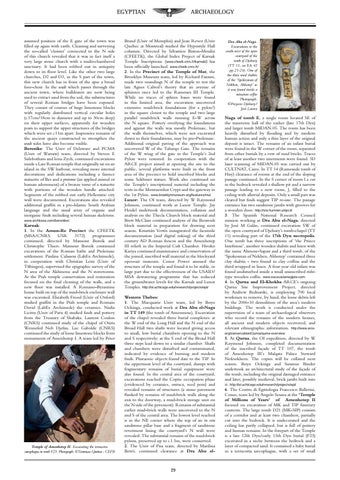
Temple of Amenhotep II. Excavating the terracotta sarcophagus in tomb F23. Photograph: ©Tommaso Quirino - CEFB
ARCHAEOLOGY
Brand (Univ of Memphis) and Jean Revez (Univ Quebec at Montreal) studied the Hypostyle Hall columns. Directed by Sébastien Biston-Moulin (CFEETK), the Global Index Project of Karnak Temple Inscriptions (www.cfeetk.cnrs.fr/karnak/) has been officially launched. www.cfeetk.cnrs.fr/ 2. In the Precinct of the Temple of Mut, the Brooklyn Museum team, led by Richard Fazzini, made two soundings N of the temple to test the late Agnes Cabrol’s theory that an avenue of sphinxes once led to the Ramesses III Temple. While no traces of sphinx bases were found in this limited area, the excavation uncovered extensive mud-brick foundations (for a pylon?) in the square closest to the temple and two large parallel mud-brick walls running E-W across the N square. Pottery overlying the foundations and against the walls was mostly Ptolemaic, but the walls themselves, which were not excavated down to their foundations, may be pre-Ptolemaic. Additional original paving of the approach was uncovered W of the Taharqo Gate. The remains of the W wing of the gate in the Temple’s 2nd Pylon were restored. In cooperation with the ARCE project aimed at opening the site to the public, several platforms were built in the front area of the precinct to hold inscribed blocks and some Sekhmet statues. Work also continued on the Temple’s inscriptional material including the texts in the Montuemhat Crypt and the gateway in the 1st Pylon. www.brooklynmuseum.org/features/mut Luxor: The OI team, directed by W Raymond Johnson, continued work at Luxor Temple. Jay Heidel undertook documentation, collation and analysis on the Thecla Church block material and Brett McClain continued analysis of the Bentresh block material in preparation for drawing next season. Krisztián Vertés inaugurated the facsimile documentation (and digital inking) of the third century AD Roman frescos and the Amenhotep III reliefs in the Imperial Cult Chamber. Hiroko Kariya continued maintenance and conservation of the joined, inscribed wall material in the blockyard open-air museum. Conor Power assessed the structure of the temple and found it to be stable, in large part due to the effectiveness of the USAID/ MSA dewatering programme that has reduced the groundwater levels for the Karnak and Luxor Temples. http://oi.uchicago.edu/research/projects/epi/ Western Thebes: 1. The Macquarie Univ team, led by Boyo Ockinga, conducted work at Dra Abu el-Naga in TT 149 (the tomb of Amenmose). Excavation of the chapel revealed three burial complexes: at the W end of the Long Hall and the N end of the Broad Hall two shafts were located giving access to small, low burial chambers opening to the N and S respectively; at the S end of the Broad Hall three steps lead down to a similar chamber. Shafts and chambers were disturbed and contaminated, indicated by evidence of burning and modern finds. Pharaonic objects found date to the TIP. In the uppermost level of the courtyard, dumps with fragmentary remains of burial equipment were also found. In the central area of the courtyard, excavations reached the Coptic occupation phase (evidenced by ceramics, ostraca, reed pens) and revealed remains of structures (a stone pavement flanked by remains of mud-brick walls along the axis to the doorway, a mud-brick storage unit on the N side of the pavement). Remains of substantial earlier mud-brick walls were uncovered to the N and S of the central area. The lowest level reached is in the NE corner where the top of an in situ sandstone pillar base and a fragment of sandstone revetment lining the courtyard’s N wall were revealed. The substantial remains of the mud-brick pylons, preserved up to c.1.5m, were conserved. 2. The Univ of Pisa team, directed by Marilina Betrò, continued clearance at Dra Abu el-
29
Dra Abu el-Naga. Excavations to the south-west of the open courtyard of the tomb of Djehuty (TT 11, see EA 42 pp.21-24). One of the three mud shabtis of the ‘Spokesman of Nekhen, Ahhotep’ as it was found inside a minature coffin Photograph: ©Proyecto Djehuty/ José Latova
Naga of tomb E, a single room located SE of the transverse hall of the earlier (late 17th Dyn) and larger tomb MIDAN.05. The room has been heavily disturbed by flooding and by modern human action and only a thin layer of the original deposit is intact. The remains of an infant burial were found in the W corner of the room, separated from other burials by a row of mud bricks. Traces of at least another two interments were found. 3D laser scanning of MIDAN.05 was carried out by CULTNAT, Cairo. In TT 14 (Ramesside tomb of Huy) clearance of rooms at the end of the sloping passage continued. In the S corner of room I a cut in the bedrock revealed a shallow pit and a narrow passage leading to a new room, J, filled to the ceiling with alluvial deposits. Only a small part was cleared but finds suggest TIP re-use. The passage entrance has two sandstone jambs with grooves for a wooden door. http://sta.humnet.unipi.it/ 3. The Spanish National Research Council mission working at Dra Abu el-Naga, directed by José M Galán, continued excavation SW of the open courtyard of Djehuty’s tomb-chapel (TT 11) revealing part of the 17th Dyn necropolis. One tomb has three inscriptions of ‘the Prince Intefmose’, another wooden shabtis and linen with the name Ahmose-Sapair and a third tomb, of the ‘Spokesman of Nekhen, Ahhotep’ contained three clay shabtis - two found in clay coffins and the third wrapped in linen. A four year old infant was found undisturbed inside a small uninscribed rishitype wooden coffin. www.excavacionegipto.com. 4. In Qurna and El-Khokha ARCE’s ongoing Qurna Site Improvement Project, directed by Andrew Bednarski, is employing 700 local workmen to remove, by hand, the loose debris left by the 2006-10 demolition of the area’s modern buildings. The work is conducted under the supervision of a team of archaeological observers who record the remains of the modern houses, all ancient and modern objects recovered, and relevant ethnographic information. http://www.arce. org/conservation/Qurna/qurna-overview
5. At Qurna, the OI expedition, directed by W Raymond Johnson, completed documentation of the inscribed façade of TT 107, the tomb of Amenhotep III’s Malqata Palace Steward Nefesekheru. The copies will be collated next season. Boyo Ockinga and Susanne Binder undertook an architectural study of the façade of the tomb, including the original damaged entrance and later, possibly medieval, brick jambs built into it. http://oi.uchicago.edu/research/projects/epi/ 6. The Centro di Egittologia Francesco Ballerini, Como, team led by Angelo Sesana at the ‘Temple of Millions of Years’ of Amenhotep II focused on excavation of MK and TIP funerary contexts. The large tomb D21 (MK-SIP) consists of a corridor and at least two chambers, partially cut into the bedrock. It is undecorated and the ceiling has partly collapsed, but is full of pottery and human remains. In the forepart of the Temple is a late 12th Dyn/early 13th Dyn burial (F23) excavated in a niche between the bedrock and a layer of compacted sand. It contained a baby burial in a terracotta sarcophagus, with a set of small