EGYPTIAN
ARCHAEOLOGY
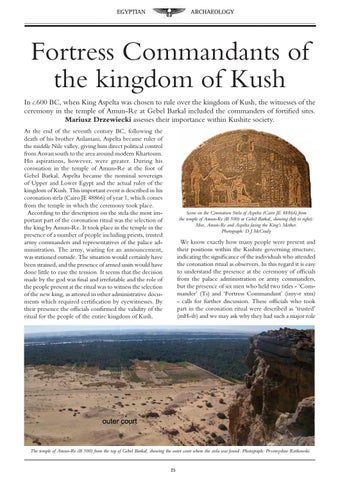
Fortress Commandants of the kingdom of Kush In c.600 BC, when King Aspelta was chosen to rule over the kingdom of Kush, the witnesses of the ceremony in the temple of Amun-Re at Gebel Barkal included the commanders of fortified sites. Mariusz Drzewiecki assesses their importance within Kushite society. At the end of the seventh century BC, following the death of his brother Anlamani, Aspelta became ruler of the middle Nile valley, giving him direct political control from Aswan south to the area around modern Khartoum. His aspirations, however, were greater. During his coronation in the temple of Amun-Re at the foot of Gebel Barkal, Aspelta became the nominal sovereign of Upper and Lower Egypt and the actual ruler of the kingdom of Kush. This important event is described in his coronation stela (Cairo JE 48866) of year 1, which comes from the temple in which the ceremony took place. According to the description on the stela the most important part of the coronation ritual was the selection of the king by Amun-Re. It took place in the temple in the presence of a number of people including priests, trusted army commanders and representatives of the palace administration. The army, waiting for an announcement, was stationed outside. The situation would certainly have been strained, and the presence of armed units would have done little to ease the tension. It seems that the decision made by the god was final and irrefutable and the role of the people present at the ritual was to witness the selection of the new king, as attested in other administrative documents which required certification by eyewitnesses. By their presence the officials confirmed the validity of the ritual for the people of the entire kingdom of Kush.
Scene on the Coronation Stela of Aspelta (Cairo JE 48866) from the temple of Amun-Re (B 500) at Gebel Barkal, showing (left to right): Mut, Amun-Re and Aspelta facing the King’s Mother. Photograph: D J McCrady
We know exactly how many people were present and their positions within the Kushite governing structure, indicating the significance of the individuals who attended the coronation ritual as observers. In this regard it is easy to understand the presence at the ceremony of officials from the palace administration or army commanders, but the presence of six men who held two titles - ‘Commander’ (Ts) and ‘Fortress Commandant’ (imy-r xtm) - calls for further discussion. These officials who took part in the coronation ritual were described as ‘trusted’ (mH-ib) and we may ask why they had such a major role
The temple of Amun-Re (B 500) from the top of Gebel Barkal, showing the outer court where the stela was found. Photograph: Przemysław Rutkowski 25