EGYPTIAN
ARCHAEOLOGY
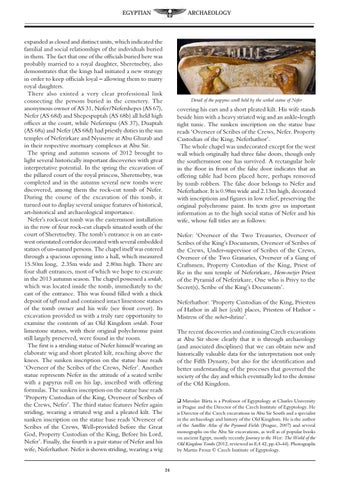
expanded as closed and distinct units, which indicated the familial and social relationships of the individuals buried in them. The fact that one of the officials buried here was probably married to a royal daughter, Sheretnebty, also demonstrates that the kings had initiated a new strategy in order to keep officials loyal – allowing them to marry royal daughters. There also existed a very clear professional link connecting the persons buried in the cemetery. The anonymous owner of AS 31, Nefer/Nefershepes (AS 67), Nefer (AS 68d) and Shepespuptah (AS 68b) all held high offices at the court, while Neferinpu (AS 37), Duaptah (AS 68a) and Nefer (AS 68d) had priestly duties in the sun temples of Neferirkare and Nyuserre at Abu Ghurab and in their respective mortuary complexes at Abu Sir. The spring and autumn seasons of 2012 brought to light several historically important discoveries with great interpretative potential. In the spring the excavation of the pillared court of the royal princess, Sheretnebty, was completed and in the autumn several new tombs were discovered, among them the rock-cut tomb of Nefer. During the course of the excavation of this tomb, it turned out to display several unique features of historical, art-historical and archaeological importance. Nefer’s rock-cut tomb was the easternmost installation in the row of four rock-cut chapels situated south of the court of Sheretnebty. The tomb’s entrance is on an eastwest orientated corridor decorated with several embedded statues of un-named persons. The chapel itself was entered through a spacious opening into a hall, which measured 15.50m long, 2.35m wide and 2.80m high. There are four shaft entrances, most of which we hope to excavate in the 2013 autumn season. The chapel possessed a serdab, which was located inside the tomb, immediately to the east of the entrance. This was found filled with a thick deposit of tafl mud and contained intact limestone statues of the tomb owner and his wife (see front cover). Its excavation provided us with a truly rare opportunity to examine the contents of an Old Kingdom serdab. Four limestone statues, with their original polychrome paint still largely preserved, were found in the room. The first is a striding statue of Nefer himself wearing an elaborate wig and short pleated kilt, reaching above the knees. The sunken inscription on the statue base reads ‘Overseer of the Scribes of the Crews, Nefer’. Another statue represents Nefer in the attitude of a seated scribe with a papyrus roll on his lap, inscribed with offering formulas. The sunken inscription on the statue base reads ‘Property Custodian of the King, Overseer of Scribes of the Crews, Nefer’. The third statue features Nefer again striding, wearing a striated wig and a pleated kilt. The sunken inscription on the statue base reads ‘Overseer of Scribes of the Crews, Well-provided before the Great God, Property Custodian of the King, Before his Lord, Nefer’. Finally, the fourth is a pair statue of Nefer and his wife, Neferhathor. Nefer is shown striding, wearing a wig
Detail of the papyrus scroll held by the scribal statue of Nefer
covering his ears and a short pleated kilt. His wife stands beside him with a heavy striated wig and an ankle-length tight tunic. The sunken inscription on the statue base reads ‘Overseer of Scribes of the Crews, Nefer. Property Custodian of the King, Neferhathor’. The whole chapel was undecorated except for the west wall which originally had three false doors, though only the southernmost one has survived. A rectangular hole in the floor in front of the false door indicates that an offering table had been placed here, perhaps removed by tomb robbers. The false door belongs to Nefer and Neferhathor. It is 0.98m wide and 2.13m high, decorated with inscriptions and figures in low relief, preserving the original polychrome paint. Its texts give us important information as to the high social status of Nefer and his wife, whose full titles are as follows: Nefer: ‘Overseer of the Two Treasuries, Overseer of Scribes of the King’s Documents, Overseer of Scribes of the Crews, Under-supervisor of Scribes of the Crews, Overseer of the Two Granaries, Overseer of a Gang of Craftsmen, Property Custodian of the King, Priest of Re in the sun temple of Neferirkare, Hem-netjer Priest of the Pyramid of Neferirkare, One who is Privy to the Secret(s), Scribe of the King’s Documents’. Neferhathor: ‘Property Custodian of the King, Priestess of Hathor in all her (cult) places, Priestess of Hathor Mistress of the nehet-shrine’. The recent discoveries and continuing Czech excavations at Abu Sir show clearly that it is through archaeology (and associated disciplines) that we can obtain new and historically valuable data for the interpretation not only of the Fifth Dynasty, but also for the identification and better understanding of the processes that governed the society of the day and which eventually led to the demise of the Old Kingdom. q Miroslav Bárta is a Professor of Egyptology at Charles University in Prague and the Director of the Czech Institute of Egyptology. He is Director of the Czech excavations in Abu Sir South and a specialist in the archaeology and history of the Old Kingdom. He is the author of the Satellite Atlas of the Pyramid Fields (Prague, 2007) and several monographs on the Abu Sir excavations, as well as of popular books on ancient Egypt, mostly recently Journey to the West: The World of the Old Kingdom Tombs (2012, reviewed in EA 42, pp.43-44). Photographs by Martin Frouz © Czech Institute of Egyptology.
24