EGYPTIAN
ARCHAEOLOGY
Digital enhancement of Rimbaud’s graffito
of 1887 and early 1888, when he was in Egypt to cash a cheque received from Menelik II (an Ethiopian ruler, and later Emperor) in exchange for a supply of arms. Archaeological work in Harwa’s courtyard started in 1999 after completing the excavation of the first subterranean level of the monument and by 2012 only a layer of debris between 20cm and 40cm deep still needed to be removed. The early excavations led to the discovery of a trench that ran all along the length of the southern wall. At the bottom we retrieved a label of the biscuits produced by Lazzaroni for the Italian army during World War II along with scraps of English newspapers dating to 1942. The discoveries suggest that the cenotaph of Harwa, like other monuments in the Assasif, may have been looted by British soldiers who used Italian prisoners as workmen. To date, just over 1,000 blocks attributable to the southern portico have been retrieved. The excavation uncovered further wall reliefs as well as the remains of the southern portico pillars which still bear traces of an
Preparing fish to be dried. Photograph: Francesco Tiradritti, 2006
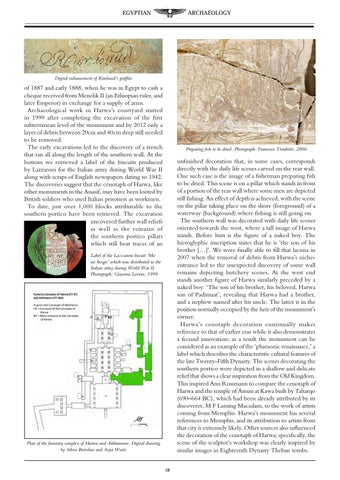
unfinished decoration that, in some cases, corresponds directly with the daily life scenes carved on the rear wall. One such case is the image of a fisherman preparing fish to be dried. This scene is on a pillar which stands in front of a portion of the rear wall where some men are depicted still fishing. An effect of depth is achieved, with the scene on the pillar taking place on the shore (foreground) of a waterway (background) where fishing is still going on. The southern wall was decorated with daily life scenes oriented towards the west, where a tall image of Harwa stands. Before him is the figure of a naked boy. The hieroglyphic inscription states that he is ‘the son of his brother […]’. We were finally able to fill that lacuna in 2007 when the removal of debris from Harwa’s nicheentrance led to the unexpected discovery of some wall remains depicting butchery scenes. At the west end stands another figure of Harwa similarly preceded by a naked boy: ‘The son of his brother, his beloved, Harwa son of Padimaat’, revealing that Harwa had a brother, and a nephew named after his uncle. The latter is in the position normally occupied by the heir of the monument’s owner. Harwa’s cenotaph decoration continually makes reference to that of earlier eras while it also demonstrates a fecund innovation; as a result the monument can be considered as an example of the ‘pharaonic renaissance,’ a label which describes the characteristic cultural features of the late Twenty-Fifth Dynasty. The scenes decorating the southern portico were depicted in a shallow and delicate relief that shows a clear inspiration from the Old Kingdom. This inspired Ann Russmann to compare the cenotaph of Harwa and the temple of Amun at Kawa built by Taharqo (690–664 BC), which had been already attributed by its discoverer, M F Laming Macadam, to the work of artists coming from Memphis. Harwa’s monument has several references to Memphis, and its attribution to artists from that city is extremely likely. Other sources also influenced the decoration of the cenotaph of Harwa; specifically, the scene of the sculptor‘s workshop was clearly inspired by similar images in Eighteenth Dynasty Theban tombs.
Label of the Lazzaroni biscuit ‘Me ne frego’ which was distributed to the Italian army during World War II. Photograph: Giacomo Lovera, 1999
Plan of the funerary complex of Harwa and Akhimenru. Digital drawing by Silvia Bertolini and Anja Wutte
18