EGYPTIAN
ARCHAEOLOGY
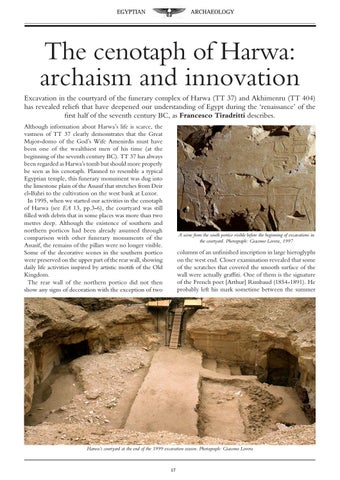
The cenotaph of Harwa: archaism and innovation Excavation in the courtyard of the funerary complex of Harwa (TT 37) and Akhimenru (TT 404) has revealed reliefs that have deepened our understanding of Egypt during the ‘renaissance’ of the first half of the seventh century BC, as Francesco Tiradritti describes. Although information about Harwa’s life is scarce, the vastness of TT 37 clearly demonstrates that the Great Major-domo of the God’s Wife Amenirdis must have been one of the wealthiest men of his time (at the beginning of the seventh century BC). TT 37 has always been regarded as Harwa’s tomb but should more properly be seen as his cenotaph. Planned to resemble a typical Egyptian temple, this funerary monument was dug into the limestone plain of the Assasif that stretches from Deir el-Bahri to the cultivation on the west bank at Luxor. In 1995, when we started our activities in the cenotaph of Harwa (see EA 13, pp.3-6), the courtyard was still filled with debris that in some places was more than two metres deep. Although the existence of southern and northern porticos had been already assumed through comparison with other funerary monuments of the Assasif, the remains of the pillars were no longer visible. Some of the decorative scenes in the southern portico were preserved on the upper part of the rear wall, showing daily life activities inspired by artistic motifs of the Old Kingdom. The rear wall of the northern portico did not then show any signs of decoration with the exception of two
A scene from the south portico visible before the beginning of excavations in the courtyard. Photograph: Giacomo Lovera, 1997
columns of an unfinished inscription in large hieroglyphs on the west end. Closer examination revealed that some of the scratches that covered the smooth surface of the wall were actually graffiti. One of them is the signature of the French poet [Arthur] Rimbaud (1854-1891). He probably left his mark sometime between the summer
Harwa’s courtyard at the end of the 1999 excavation season. Photograph: Giacomo Lovera
17