EGYPTIAN
ARCHAEOLOGY
Fourteen shells in silver mounts
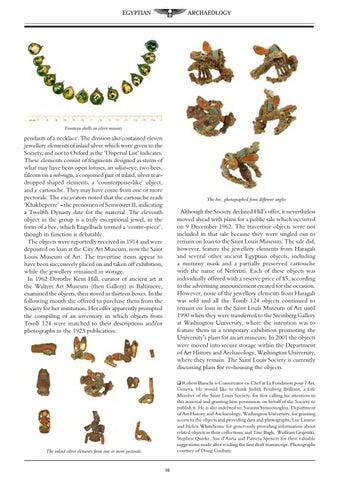
pendants of a necklace. The division also contained eleven jewellery elements of inlaid silver which were given to the Society, and not to Oxford as the ‘Dispersal List’ indicates. These elements consist of fragments designed as stems of what may have been open lotuses, an udjat-eye, two bees, falcons on a neb-sign, a conjoined pair of inlaid, silver teardropped shaped elements, a ‘counterpoise-like’ object, and a cartouche. They may have come from one or more pectorals. The excavators noted that the cartouche reads ‘Khakheperre’ - the prenomen of Senwosret II, indicating a Twelfth Dynasty date for the material. The eleventh object in the group is a truly exceptional jewel, in the form of a bee, which Engelbach termed a ‘centre-piece’, though its function is debatable. The objects were reportedly received in 1914 and were deposited on loan at the City Art Museum, now the Saint Louis Museum of Art. The travertine items appear to have been successively placed on and taken off exhibition, while the jewellery remained in storage. In 1962 Dorothy Kent Hill, curator of ancient art at the Walters Art Museum (then Gallery) in Baltimore, examined the objects, then stored in thirteen boxes. In the following month she offered to purchase them from the Society for her institution. Her offer apparently prompted the compiling of an inventory in which objects from Tomb 124 were matched to their descriptions and/or photographs in the 1923 publication.
The bee, photographed from different angles
Although the Society declined Hill’s offer, it nevertheless moved ahead with plans for a public sale which occurred on 9 December 1962. The travertine objects were not included in that sale because they were singled out to remain on loan to the Saint Louis Museum. The sale did, however, feature the jewellery elements from Haragah and several other ancient Egyptian objects, including a mummy mask and a partially preserved cartouche with the name of Nefertiti. Each of these objects was individually offered with a reserve price of $5, according to the advertising announcement created for the occasion. However, none of the jewellery elements from Haragah was sold and all the Tomb 124 objects continued to remain on loan in the Saint Louis Museum of Art until 1990 when they were transferred to the Steinberg Gallery at Washington University, where the intention was to feature them in a temporary exhibition promoting the University’s plans for an art museum. In 2001 the objects were moved into secure storage within the Department of Art History and Archaeology, Washington University, where they remain. The Saint Louis Society is currently discussing plans for re-housing the objects. q Robert Bianchi is Conservator en Chef at La Fondation pour l’Art, Geneva. He would like to thank Judith Feinberg Brilliant, a Life Member of the Saint Louis Society, for first calling his attention to this material and granting him permission on behalf of the Society to publish it. He is also indebted to; Sarantis Symeonoglou, Department of Art History and Archaeology, Washington University, for granting access to the objects and providing data and photographs; Luc Limme and Helen Whitehouse for generously providing information about related objects in their collections; and Tine Bagh, Wolfram Grajetzki, Stephen Quirke, Sue d’Auria and Patricia Spencer for their valuable suggestions made after reading the first draft manuscript. Photographs courtsey of Doug Gaubatz.
The inlaid silver elements from one or more pectorals 16