EGYPTIAN
ARCHAEOLOGY
From a tomb at Haragah to Saint Louis, Missouri Material from early excavations in Egypt was either assigned to the Museum in Cairo or was legally distributed to museums and other institutions that had funded the fieldwork. Robert Bianchi describes how objects from the 1913-14 excavation at Haragah found their way to Saint Louis. I thought that I was very familiar with the Egyptian collections of the Saint Louis Art Museum in Missouri, as well as with those housed on the city’s Washington University campus, so I was surprised a few years ago when Judith Feinberg Brilliant told me that there were ancient Egyptian objects, probably from Petrie’s excavations, in the possession of the Saint Louis Society of the Archaeological Institute of America. Judith arranged for me to visit Sarantis Symeonoglou, Professor of Art History and Archaeology at Washington University, where the objects were on loan. They turned out to be ancient Egyptian jewellery elements and cosmetic items of travertine from Haragah (on the edge of the Fayum, near Lahun). Judith also granted me free access to the archives of the Society and sifting through the documentation, some of it in original manuscripts but most of it in photocopies, we gradually began to reconstruct the events which led to the arrival of the objects in Saint Louis. In 1912, the Saint Louis Society of the Archaeological Institute of America voted to suspend funding for excavations in MesoAmerica, presumably to fund excavations elsewhere. The Society’s Minutes of 1915 suggest that an association had been formed in 1914 and that excavations in Egypt were to replace MesoAmerica as the recipient of the funding. The documentation also suggests that the funds for work in Egypt, preferably at Amarna, were to be funneled through the American Branch (based in Boston) of the Egypt Exploration Fund (now Society). Confirmation of that decision and of its ramifications could not be independently established, but the Minutes are misleading since the EES did not begin work at Amarna until 1921. The members of the Saint
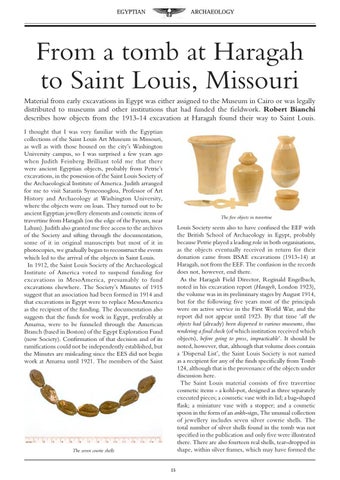
The five objects in travertine
Louis Society seem also to have confused the EEF with the British School of Archaeology in Egypt, probably because Petrie played a leading role in both organisations, as the objects eventually received in return for their donation came from BSAE excavations (1913-14) at Haragah, not from the EEF. The confusion in the records does not, however, end there. As the Haragah Field Director, Reginald Engelbach, noted in his excavation report (Harageh, London 1923), the volume was in its preliminary stages by August 1914, but for the following five years most of the principals were on active service in the First World War, and the report did not appear until 1923. By that time ‘all the objects had (already) been dispersed to various museums, thus rendering a final check (of which institution received which objects), before going to press, impracticable’. It should be noted, however, that, although that volume does contain a ‘Dispersal List’, the Saint Louis Society is not named as a recipient for any of the finds specifically from Tomb 124, although that is the provenance of the objects under discussion here. The Saint Louis material consists of five travertine cosmetic items - a kohl-pot, designed as three separately executed pieces; a cosmetic vase with its lid; a bag-shaped flask; a miniature vase with a stopper; and a cosmetic spoon in the form of an ankh-sign, The unusual collection of jewellery includes seven silver cowrie shells. The total number of silver shells found in the tomb was not specified in the publication and only five were illustrated there. There are also fourteen real shells, tear-dropped in shape, within silver frames, which may have formed the
The seven cowrie shells 15