EGYPTIAN
ARCHAEOLOGY
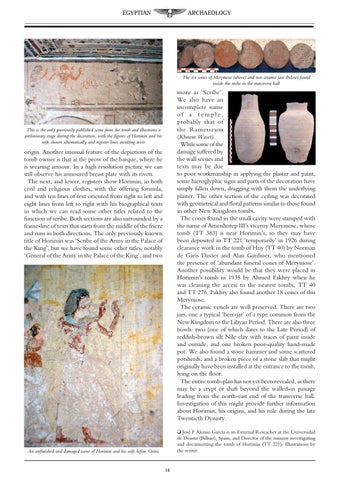
The six cones of Merymose (above) and two ceramic jars (below) found inside the niche in the transverse hall
more as ‘Scribe’. We also have an incomplete name of a temple, probably that of the Ramesseum (Khnem Waset). While some of the damage suffered by the wall scenes and texts may be due to poor workmanship in applying the plaster and paint, some hieroglyphic signs and parts of the decoration have simply fallen down, dragging with them the underlying plaster. The other section of the ceiling was decorated with geometrical and floral patterns similar to those found in other New Kingdom tombs. The cones found in the small cavity were stamped with the name of Amenhotep III’s viceroy Merymose, whose tomb (TT 383) is near Horimin’s, so they may have been deposited in TT 221 ‘temporarily’ in 1926 during clearance work in the tomb of Huy (TT 40) by Norman de Garis Davies and Alan Gardiner, who mentioned the presence of ‘abundant funeral cones of Merymose’. Another possibility would be that they were placed in Horimin’s tomb in 1935 by Ahmed Fakhry when he was cleaning the access to the nearest tombs, TT 40 and TT 276. Fakhry also found another 18 cones of this Merymose. The ceramic vessels are well preserved. There are two jars, one a typical ‘beer-jar’ of a type common from the New Kingdom to the Libyan Period. There are also three bowls: two (one of which dates to the Late Period) of reddish-brown silt Nile clay with traces of paint inside and outside, and one broken poor-quality hand-made pot. We also found a stone hammer and some scattered potsherds, and a broken piece of a stone slab that might originally have been installed at the entrance to the tomb, lying on the floor. The entire tomb-plan has not yet been revealed, as there may be a crypt or shaft beyond the walled-in passage leading from the north-east end of the transverse hall. Investigation of this might provide further information about Horimin, his origins, and his role during the late Twentieth Dynasty.
This is the only previously published scene from the tomb and illustrates a preliminary stage during the decoration, with the figures of Horimin and his wife shown schematically and register lines awaiting texts
origin. Another unusual feature of the depictions of the tomb owner is that at the prow of the barque, where he is wearing armour. In a high resolution picture we can still observe his armoured breast plate with its rivets. The next, and lower, registers show Horimin, in both civil and religious clothes, with the offering formula, and with ten lines of text oriented from right to left and eight lines from left to right with his biographical texts in which we can read some other titles related to the function of scribe. Both sections are also surrounded by a frame-line of texts that starts from the middle of the frieze and runs in both directions. The only previously known title of Horimin was ‘Scribe of the Army in the Palace of the King’, but we have found some other titles, notably ‘General of the Army in the Palace of the King’, and two
q José F Alonso García is an External Reseacher at the Universidad de Deusto (Bilbao), Spain, and Director of the mission investigating and documenting the tomb of Horimin (TT 221). Illustrations by the writer.
An unfinished and damaged scene of Horimin and his wife before Osiris 14