EGYPTIAN
ARCHAEOLOGY
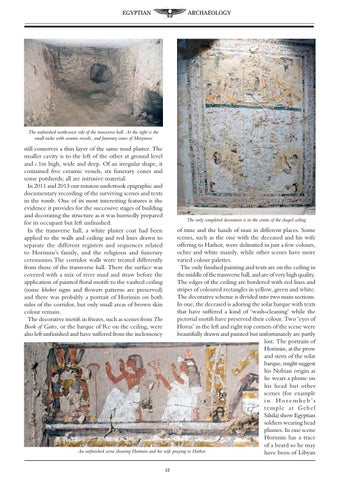
The unfinished north-west side of the transverse hall. At the right is the small niche with ceramic vessels, and funerary cones of Merymose
still conserves a thin layer of the same mud plaster. The smaller cavity is to the left of the other at ground level and c.1m high, wide and deep. Of an irregular shape, it contained five ceramic vessels, six funerary cones and some potsherds; all are intrusive material. In 2011 and 2013 our mission undertook epigraphic and documentary recording of the surviving scenes and texts in the tomb. One of its most interesting features is the evidence it provides for the successive stages of building and decorating the structure as it was hurriedly prepared for its occupant but left unfinished. In the transverse hall, a white plaster coat had been applied to the walls and ceiling and red lines drawn to separate the different registers and sequences related to Horimin’s family, and the religious and funerary ceremonies.The corridor walls were treated differently from those of the transverse hall. There the surface was covered with a mix of river mud and straw before the application of painted floral motifs to the vaulted ceiling (some kheker signs and flowers patterns are preserved) and there was probably a portrait of Horimin on both sides of the corridor, but only small areas of brown skin colour remain. The decorative motifs in friezes, such as scenes from The Book of Gates, or the barque of Re on the ceiling, were also left unfinished and have suffered from the inclemency
The only completed decoration is in the centre of the chapel ceiling
of time and the hands of man in different places. Some scenes, such as the one with the deceased and his wife offering to Hathor, were delimited in just a few colours, ochre and white mainly, while other scenes have more varied colour palettes. The only finished painting and texts are on the ceiling in the middle of the transverse hall, and are of very high quality. The edges of the ceiling are bordered with red lines and stripes of coloured rectangles in yellow, green and white. The decorative scheme is divided into two main sections. In one, the deceased is adoring the solar barque with texts that have suffered a kind of ‘wash-cleaning’ while the pictorial motifs have preserved their colour. Two ‘eyes of Horus’ in the left and right top corners of the scene were beautifully drawn and painted but unfortunately are partly lost. The portraits of Horimin, at the prow and stern of the solar barque, might suggest his Nubian origin as he wears a plume on his head but other scenes (for example in Horemheb’s temple at Gebel Silsila) show Egyptian soldiers wearing head plumes. In one scene Horimin has a trace of a beard so he may An unfinished scene showing Horimin and his wife praying to Hathor have been of Libyan 12