EGYPTIAN
ARCHAEOLOGY
The tomb of Horimin In November 2011 and January 2013 an epigraphic mission took place to record the largely forgotten tomb of Horimin in the Theban necropolis, as José F Alonso García describes. The Ramesside tomb of Horimin (TT 221) is situated in Gurnet Murai on the west bank at Luxor within a group of New Kingdom burials including three viceroys: Huy (TT 40), Merymose (TT 383) and Nakht (TT 382), as well as other interesting individuals, including Sobekmose (TT 275) and Amenemope (TT 276). Nineteenth century visitors to the area, such as Karl Lepsius and John Gardner Wilkinson, described the neighbouring tomb of Huy, but they did not mention that of Horimin, and the 1913 Topographical Catalogue of Arthur Weigall and Alan Gardiner classified the tomb as ‘not studied yet’. In 1935 Marcel Baud reproduced one scene from the decorated chamber, and in the following year, in the notebook of Norman de Garis Davies, there is an entry noting TT 221. Some of the tomb’s paintings were partially photographed, probably in the 1940s, by the Oriental Institute of Chicago whose archivist, John Larson, kindly sent the writer copies to collate with images taken recently. Eventually the tomb was included in the 1960 edition of The Topographical Bibliography, but still remained unpublished. We first gained access to the tomb in 2009 and found that what would have been its access via a forecourt was covered with domestic debris and waste from the nearest
Cleaning the entrance to the tomb of Horimin in November 2009
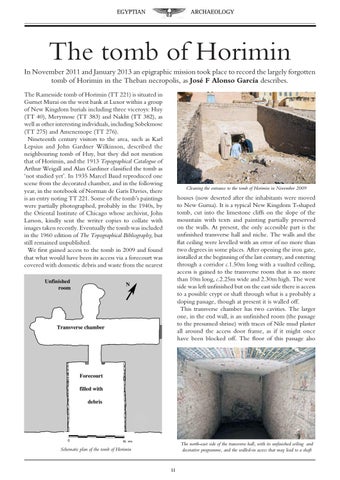
houses (now deserted after the inhabitants were moved to New Gurna). It is a typical New Kingdom T-shaped tomb, cut into the limestone cliffs on the slope of the mountain with texts and painting partially preserved on the walls. At present, the only accessible part is the unfinished transverse hall and niche. The walls and the flat ceiling were levelled with an error of no more than two degrees in some places. After opening the iron gate, installed at the beginning of the last century, and entering through a corridor c.1.50m long with a vaulted ceiling, access is gained to the transverse room that is no more than 10m long, c.2.25m wide and 2.30m high. The west side was left unfinished but on the east side there is access to a possible crypt or shaft through what is a probably a sloping passage, though at present it is walled off. This transverse chamber has two cavities. The larger one, in the end wall, is an unfinished room (the passage to the presumed shrine) with traces of Nile mud plaster all around the access door frame, as if it might once have been blocked off. The floor of this passage also
The north-east side of the transverse hall, with its unfinished ceiling and decorative programme, and the walled-in access that may lead to a shaft
Schematic plan of the tomb of Horimin
11