EGYPTIAN
ARCHAEOLOGY
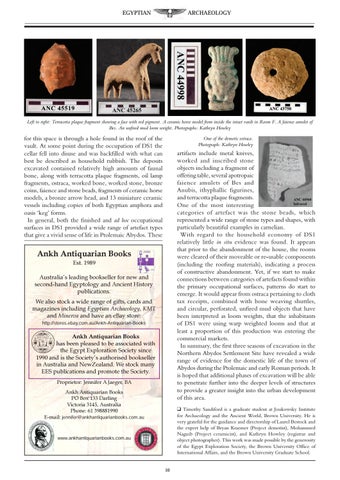
Left to right: Terracotta plaque fragment showing a face with red pigment. A ceramic horse model from inside the intact vault in Room F. A faience amulet of Bes. An unfired mud loom weight. Photographs: Kathryn Howley
for this space is through a hole found in the roof of the vault. At some point during the occupation of DS1 the cellar fell into disuse and was backfilled with what can best be described as household rubbish. The deposits excavated contained relatively high amounts of faunal bone, along with terracotta plaque fragments, oil lamp fragments, ostraca, worked bone, worked stone, bronze coins, faience and stone beads, fragments of ceramic horse models, a bronze arrow head, and 13 miniature ceramic vessels including copies of both Egyptian amphora and oasis ‘keg’ forms. In general, both the finished and ad hoc occupational surfaces in DS1 provided a wide range of artefact types that give a vivid sense of life in Ptolemaic Abydos. These
One of the demotic ostraca. Photograph: Kathryn Howley
artifacts include metal knives, worked and inscribed stone objects including a fragment of offering table, several apotropaic faience amulets of Bes and Anubis, ithyphallic figurines, and terracotta plaque fragments. One of the most interesting categories of artefact was the stone beads, which represented a wide range of stone types and shapes, with particularly beautiful examples in carnelian. With regard to the household economy of DS1 relatively little in situ evidence was found. It appears that prior to the abandonment of the house, the rooms were cleared of their moveable or re-usable components (including the roofing materials), indicating a process of constructive abandonment. Yet, if we start to make connections between categories of artefacts found within the primary occupational surfaces, patterns do start to emerge. It would appear from ostraca pertaining to cloth tax receipts, combined with bone weaving shuttles, and circular, perforated, unfired mud objects that have been interpreted as loom weights, that the inhabitants of DS1 were using warp weighted looms and that at least a proportion of this production was entering the commercial markets. In summary, the first three seasons of excavation in the Northern Abydos Settlement Site have revealed a wide range of evidence for the domestic life of the town of Abydos during the Ptolemaic and early Roman periods. It is hoped that additional phases of excavation will be able to penetrate further into the deeper levels of structures to provide a greater insight into the urban development of this area.
Ankh Antiquarian Books Est. 1989 Australia’s leading bookseller for new and second-hand Egyptology and Ancient History publications. We also stock a wide range of gifts, cards and magazines including Egyptian Archaeology, KMT and Minerva and have an eBay store: http://stores.ebay.com.au/Ankh-Antiquarian-Books
Ankh Antiquarian Books has been pleased to be associated with the Egypt Exploration Society since 1990 and is the Society’s authorised bookseller in Australia and NewZealand. We stock many EES publications and promote the Society. Proprietor: Jennifer A Jaeger, BA Ankh Antiquarian Books PO Box 133 Darling Victoria 3145, Australia Phone: 61 398881990
q Timothy Sandiford is a graduate student at Joukowsky Institute for Archaeology and the Ancient World, Brown University. He is very grateful for the guidance and directorship of Laurel Bestock and the expert help of Bryan Kraemer (Project demotist), Mohammed Naguib (Project ceramicist), and Kathryn Howley (registrar and object photographer). This work was made possible by the generosity of the Egypt Exploration Society, the Brown University Office of International Affairs, and the Brown University Graduate School.
E-mail: jennifer@ankhantiquarianbooks.com.au
www.ankhantiquarianbooks.com.au
10