EGYPTIAN
ARCHAEOLOGY
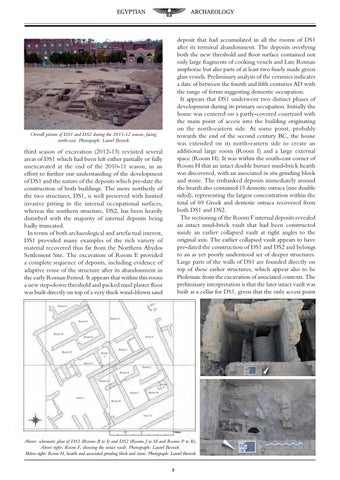
deposit that had accumulated in all the rooms of DS1 after its terminal abandonment. The deposits overlying both the new threshold and floor surface contained not only large fragments of cooking vessels and Late Roman amphorae but also parts of at least two finely made green glass vessels. Preliminary analysis of the ceramics indicates a date of between the fourth and fifth centuries AD with the range of forms suggesting domestic occupation. It appears that DS1 underwent two distinct phases of development during its primary occupation. Initially the house was centered on a partly-covered courtyard with the main point of access into the building originating on the north-eastern side. At some point, probably towards the end of the second century BC, the house was extended on its north-eastern side to create an additional large room (Room I) and a large external space (Room H). It was within the south-east corner of Room H that an intact double burner mud-brick hearth was discovered, with an associated in situ grinding block and stone. The embanked deposits immediately around the hearth also contained 15 demotic ostraca (one double sided), representing the largest concentration within the total of 69 Greek and demotic ostraca recovered from both DS1 and DS2. The sectioning of the Room F internal deposits revealed an intact mud-brick vault that had been constructed inside an earlier collapsed vault at right angles to the original axis. The earlier collapsed vault appears to have pre-dated the construction of DS1 and DS2 and belongs to an as yet poorly understood set of deeper structures. Large parts of the walls of DS1 are founded directly on top of these earlier structures, which appear also to be Ptolemaic from the excavation of associated contexts. The preliminary interpretation is that the later intact vault was built as a cellar for DS1, given that the only access point
Overall picture of DS1 and DS2 during the 2011-12 season, facing north-east. Photograph: Laurel Bestock
third season of excavation (2012-13) revisited several areas of DS1 which had been left either partially or fully unexcavated at the end of the 2010-11 season, in an effort to further our understanding of the development of DS1 and the nature of the deposits which pre-date the construction of both buildings. The more northerly of the two structures, DS1, is well preserved with limited invasive pitting in the internal occupational surfaces, whereas the southern structure, DS2, has been heavily disturbed with the majority of internal deposits being badly truncated. In terms of both archaeological and artefactual interest, DS1 provided many examples of the rich variety of material recovered thus far from the Northern Abydos Settlement Site. The excavation of Room E provided a complete sequence of deposits, including evidence of adaptive reuse of the structure after its abandonment in the early Roman Period. It appears that within this room a new step-down threshold and packed mud plaster floor was built directly on top of a very thick wind-blown sand
Above: schematic plan of DS1 (Rooms B to I) and DS2 (Rooms J to M and Rooms P to R). Above right: Room F, showing the intact vault. Photograph: Laurel Bestock. Below right: Room H, hearth and associated grinding block and stone. Photograph: Laurel Bestock