EGYPTIAN
ARCHAEOLOGY
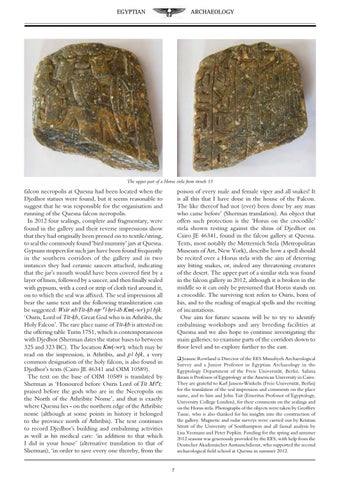
The upper part of a Horus stela from trench 13
poison of every male and female viper and all snakes! It is all this that I have done in the house of the Falcon. The like thereof had not (ever) been done by any man who came before’ (Sherman translation). An object that offers such protection is the ‘Horus on the crocodile’ stela shown resting against the shins of Djedhor on Cairo JE 46341, found in the falcon gallery at Quesna. Texts, most notably the Metternich Stela (Metropolitan Museum of Art, New York), describe how a spell should be recited over a Horus stela with the aim of deterring any biting snakes, or, indeed any threatening creatures of the desert. The upper part of a similar stela was found in the falcon gallery in 2012, although it is broken in the middle so it can only be presumed that Horus stands on a crocodile. The surviving text refers to Osiris, born of Isis, and to the reading of magical spells and the reciting of incantations. One aim for future seasons will be to try to identify embalming workshops and any breeding facilities at Quesna and we also hope to continue investigating the main galleries: to examine parts of the corridors down to floor level and to explore further to the east.
falcon necropolis at Quesna had been located when the Djedhor statues were found, but it seems reasonable to suggest that he was responsible for the organisation and running of the Quesna falcon necropolis. In 2012 four sealings, complete and fragmentary, were found in the gallery and their reverse impressions show that they had originally been pressed on to textile/string, to seal the commonly found ‘bird mummy’ jars at Quesna. Gypsum stoppers for such jars have been found frequently in the southern corridors of the gallery and in two instances they had ceramic saucers attached, indicating that the jar’s mouth would have been covered first by a layer of linen, followed by a saucer, and then finally sealed with gypsum, with a cord or strip of cloth tied around it, on to which the seal was affixed. The seal impressions all bear the same text and the following transliteration can be suggested: Wsir nb IAt-qb nTr aA Hri-ib Km(-wr) pA bjk. ‘Osiris, Lord of IAt-qb, Great God who is in Athribis, the Holy Falcon’. The rare place name of IAt-qb is attested on the offering table Turin 1751, which is contemporaneous with Djedhor (Sherman dates the statue bases to between 325 and 323 BC). The location Km(-wr), which may be read on the impression, is Athribis, and pA bjk, a very common designation of the holy falcon, is also found in Djedhor’s texts (Cairo JE 46341 and OIM 10589). The text on the base of OIM 10589 is translated by Sherman as ‘Honoured before Osiris Lord of IAt MAat; praised before the gods who are in the Necropolis on the North of the Athribite Nome’, and that is exactly where Quesna lies - on the northern edge of the Athribite nome (although at some points in history it belonged to the province north of Athribis). The text continues to record Djedhor’s building and embalming activities as well as his medical care: ‘in addition to that which I did in your house’ (alternative translation to that of Sherman), ‘in order to save every one thereby, from the
q Joanne Rowland is Director of the EES Minufiyeh Archaeological Survey and a Junior Professor in Egyptian Archaeology in the Egyptology Department of the Freie Universität, Berlin. Salima Ikram is Professor of Egyptology at the American University in Cairo. They are grateful to Karl Jansen-Winkeln (Freie Universität, Berlin) for the translation of the seal impression and comments on the place name, and to him and John Tait (Emeritus Professor of Egyptology, University College London), for their comments on the sealings and on the Horus stela. Photographs of the objects were taken by Geoffrey Tassie, who is also thanked for his insights into the construction of the gallery. Magnetic and radar surveys were carried out by Kristian Strutt of the University of Southampton and all faunal analysis by Lisa Yeomans and Peter Popkin. Funding for the spring and summer 2012 seasons was generously provided by the EES, with help from the Deutscher Akademischer Austauschdienst, who supported the second archaeological field school at Quesna in summer 2012.