EGYPTIAN
ARCHAEOLOGY
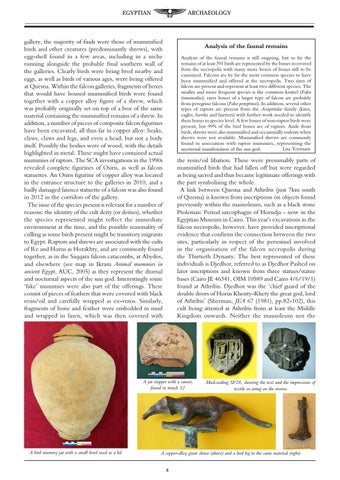
gallery, the majority of finds were those of mummified birds and other creatures (predominantly shrews), with egg-shell found in a few areas, including in a niche running alongside the probable final southern wall of the galleries. Clearly birds were being bred nearby and eggs, as well as birds of various ages, were being offered at Quesna. Within the falcon galleries, fragments of boxes that would have housed mummified birds were found together with a copper alloy figure of a shrew, which was probably originally set on top of a box of the same material containing the mummified remains of a shrew. In addition, a number of pieces of composite falcon figurines have been excavated, all thus far in copper alloy: beaks, claws, claws and legs, and even a head, but not a body itself. Possibly the bodies were of wood, with the details highlighted in metal. These might have contained actual mummies of raptors. The SCA investigations in the 1990s revealed complete figurines of Osiris, as well as falcon statuettes. An Osiris figurine of copper alloy was located in the entrance structure to the galleries in 2010, and a badly damaged faience statuette of a falcon was also found in 2012 in the corridors of the gallery. The issue of the species present is relevant for a number of reasons: the identity of the cult deity (or deities), whether the species represented might reflect the immediate environment at the time, and the possible seasonality of culling as some birds present might be transitory migrants to Egypt. Raptors and shrews are associated with the cults of Re and Horus as Horakhty, and are commonly found together, as in the Saqqara falcon catacombs, at Abydos, and elsewhere (see map in Ikram Animal mummies in ancient Egypt, AUC, 2005) as they represent the diurnal and nocturnal aspects of the sun god. Interestingly some ‘fake’ mummies were also part of the offerings. These consist of pieces of feathers that were covered with black resin/oil and carefully wrapped as ex-votos. Similarly, fragments of bone and feather were embedded in mud and wrapped in linen, which was then covered with
Analysis of the faunal remains Analysis of the faunal remains is still ongoing, but so far the remains of at least 391 birds are represented by the bones recovered from the necropolis with many more boxes of bones still to be examined. Falcons are by far the most common species to have been mummified and offered at the necropolis. Two sizes of falcon are present and represent at least two different species. The smaller and more frequent species is the common kestrel (Falco tinnunculus); rarer bones of a larger type of falcon are probably from peregrine falcons (Falco peregrinus). In addition, several other types of raptors are present from the Accipitridae family (kites, eagles, hawks and harriers) with further work needed to identify these bones to species level. A few bones of non-raptor birds were present, but 99% of the bird bones are of raptors. Aside from birds, shrews were also mummified and occasionally rodents when shrews were not available. Mummified shrews are commonly found in association with raptor mummies, representing the Lisa Yeomans nocturnal manifestation of the sun god.
the resin/oil libation. These were presumably parts of mummified birds that had fallen off but were regarded as being sacred and thus became legitimate offerings with the part symbolising the whole. A link between Quesna and Athribis (just 7km south of Quesna) is known from inscriptions on objects found previously within the mausoleum, such as a black stone Ptolemaic Period sarcophagus of Horudja - now in the Egyptian Museum in Cairo. This year’s excavations in the falcon necropolis, however, have provided inscriptional evidence that confirms the connection between the two sites, particularly in respect of the personnel involved in the organisation of the falcon necropolis during the Thirtieth Dynasty. The best represented of these individuals is Djedhor, referred to as Djedhor Pashed on later inscriptions and known from three statues/statue bases (Cairo JE 46341, OIM 10589 and Cairo 4/6/19/1) found at Athribis. Djedhor was the ‘chief guard of the double doors of Horus Khenty-Khety the great god, lord of Athribis’ (Sherman, JEA 67 (1981), pp.82-102), this cult being attested at Athribis from at least the Middle Kingdom onwards. Neither the mausoleum nor the
A jar stopper with a saucer, found in trench 12
A bird mummy jar with a small bowl used as a lid
Mud-sealing SF28, showing the text and the impressions of textile or string on the reverse
A copper-alloy giant shrew (above) and a bird leg in the same material (right)