EGYPTIAN
ARCHAEOLOGY
The falcon necropolis at Quesna In 2012 the EES Minufiyeh Survey team excavated in the falcon necropolis at Quesna and revealed structures and artefacts which provided information on the building of the galleries themselves and their connection to Athribis as Joanne Rowland and Salima Ikram describe.
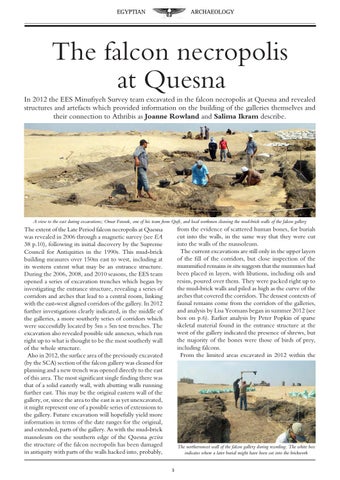
A view to the east during excavations; Omar Farouk, one of his team from Quft, and local workmen cleaning the mud-brick walls of the falcon gallery
from the evidence of scattered human bones, for burials cut into the walls, in the same way that they were cut into the walls of the mausoleum. The current excavations are still only in the upper layers of the fill of the corridors, but close inspection of the mummified remains in situ suggests that the mummies had been placed in layers, with libations, including oils and resins, poured over them. They were packed right up to the mud-brick walls and piled as high as the curve of the arches that covered the corridors. The densest contexts of faunal remains come from the corridors of the galleries, and analysis by Lisa Yeomans began in summer 2012 (see box on p.6). Earlier analysis by Peter Popkin of sparse skeletal material found in the entrance structure at the west of the gallery indicated the presence of shrews, but the majority of the bones were those of birds of prey, including falcons. From the limited areas excavated in 2012 within the
The extent of the Late Period falcon necropolis at Quesna was revealed in 2006 through a magnetic survey (see EA 38 p.10), following its initial discovery by the Supreme Council for Antiquities in the 1990s. This mud-brick building measures over 150m east to west, including at its western extent what may be an entrance structure. During the 2006, 2008, and 2010 seasons, the EES team opened a series of excavation trenches which began by investigating the entrance structure, revealing a series of corridors and arches that lead to a central room, linking with the east-west aligned corridors of the gallery. In 2012 further investigations clearly indicated, in the middle of the galleries, a more southerly series of corridors which were successfully located by 5m x 5m test trenches. The excavation also revealed possible side annexes, which run right up to what is thought to be the most southerly wall of the whole structure. Also in 2012, the surface area of the previously excavated (by the SCA) section of the falcon gallery was cleaned for planning and a new trench was opened directly to the east of this area. The most significant single finding there was that of a solid easterly wall, with abutting walls running further east. This may be the original eastern wall of the gallery, or, since the area to the east is as yet unexcavated, it might represent one of a possible series of extensions to the gallery. Future excavation will hopefully yield more information in terms of the date ranges for the original, and extended, parts of the gallery. As with the mud-brick mausoleum on the southern edge of the Quesna gezira the structure of the falcon necropolis has been damaged in antiquity with parts of the walls hacked into, probably,
The northernmost wall of the falcon gallery during recording. The white box indicates where a later burial might have been cut into the brickwork