EGYPTIAN
ARCHAEOLOGY
EES Director’s Report for 2011-12
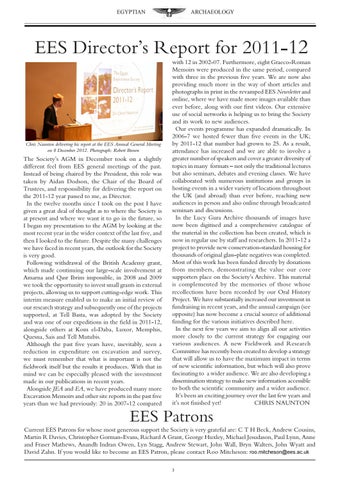
Chris Naunton delivering his report at the EES Annual General Meeting on 8 December 2012. Photograph: Robert Brown
The Society’s AGM in December took on a slightly different feel from EES general meetings of the past. Instead of being chaired by the President, this role was taken by Aidan Dodson, the Chair of the Board of Trustees, and responsibility for delivering the report on the 2011-12 year passed to me, as Director. In the twelve months since I took on the post I have given a great deal of thought as to where the Society is at present and where we want it to go in the future, so I began my presentation to the AGM by looking at the most recent year in the wider context of the last five, and then I looked to the future. Despite the many challenges we have faced in recent years, the outlook for the Society is very good. Following withdrawal of the British Academy grant, which made continuing our large-scale involvement at Amarna and Qasr Ibrim impossible, in 2008 and 2009 we took the opportunity to invest small grants in external projects, allowing us to support cutting-edge work. This interim measure enabled us to make an initial review of our research strategy and subsequently one of the projects supported, at Tell Basta, was adopted by the Society and was one of our expeditions in the field in 2011-12, alongside others at Kom el-Daba, Luxor, Memphis, Quesna, Sais and Tell Mutubis. Although the past five years have, inevitably, seen a reduction in expenditure on excavation and survey, we must remember that what is important is not the fieldwork itself but the results it produces. With that in mind we can be especially pleased with the investment made in our publications in recent years. Alongside JEA and EA, we have produced many more Excavation Memoirs and other site reports in the past five years than we had previously: 20 in 2007-12 compared
with 12 in 2002-07. Furthermore, eight Graeco-Roman Memoirs were produced in the same period, compared with three in the previous five years. We are now also providing much more in the way of short articles and photographs in print in the revamped EES Newsletter and online, where we have made more images available than ever before, along with our first videos. Our extensive use of social networks is helping us to bring the Society and its work to new audiences. Our events programme has expanded dramatically. In 2006-7 we hosted fewer than five events in the UK; by 2011-12 that number had grown to 25. As a result, attendance has increased and we are able to involve a greater number of speakers and cover a greater diversity of topics in many formats – not only the traditional lectures but also seminars, debates and evening classes. We have collaborated with numerous institutions and groups in hosting events in a wider variety of locations throughout the UK (and abroad) than ever before, reaching new audiences in person and also online through broadcasted seminars and discussions. In the Lucy Gura Archive thousands of images have now been digitised and a comprehensive catalogue of the material in the collection has been created, which is now in regular use by staff and researchers. In 2011-12 a project to provide new conservation-standard housing for thousands of original glass-plate negatives was completed. Most of this work has been funded directly by donations from members, demonstrating the value our core supporters place on the Society’s Archive. This material is complemented by the memories of those whose recollections have been recorded by our Oral History Project. We have substantially increased our investment in fundraising in recent years, and the annual campaign (see opposite) has now become a crucial source of additional funding for the various initiatives described here. In the next few years we aim to align all our activities more closely to the current strategy for engaging our various audiences. A new Fieldwork and Research Committee has recently been created to develop a strategy that will allow us to have the maximum impact in terms of new scientific information, but which will also prove fascinating to a wider audience. We are also developing a dissemination strategy to make new information accessible to both the scientific community and a wider audience. It’s been an exciting journey over the last few years and it’s not finished yet! CHRIS NAUNTON
EES Patrons Current EES Patrons for whose most generous support the Society is very grateful are: C T H Beck, Andrew Cousins, Martin R Davies, Christopher Gorman-Evans, Richard A Grant, George Huxley, Michael Jesudason, Paul Lynn, Anne and Fraser Mathews, Anandh Indran Owen, Lyn Stagg, Andrew Stewart, John Wall, Bryn Walters, John Wyatt and David Zahn. If you would like to become an EES Patron, please contact Roo Mitcheson: roo.mitcheson@ees.ac.uk