EGYPTIAN
easily process while for the student and the Egyptologist, the detail in the book could be blunted by the lack of notes or references in the text. There is so much interesting, insightful and indeed provocative information here that the experienced Egyptologist is likely to ask over and over again, ‘where did that come from?’. It is, however, not easy to find the source without further work. One simple example will suffice. On pp.96– 97 is ‘It is worth noting that his [Djedefre’s] pyramid complex was the tallest one of all, and so the closest to the sun’. Really? This does need qualification; was it taller, or on the highest ground, or the steepest? Sometimes a scholar is mentioned, but one searches in vain in the bibliography for that chapter for the source - so on p.102 the author refers to the work of Spence, but what? (similarly Anthes on p.105, or Franke on p.276). About the only in-text references are quotes; I note that on p.270, Kemp 1989 and on p.275, Lehner 2000 are not in the bibliography, at least for the chapter in question. Minimal use of references is inevitable in a popular book, but the amount of information here is tantalizing and leaves one wanting more. Fuller indexes would aid access to this mine of information. Bárta’s work is impeccable. If you are interested in the Old Kingdom, or in the development of the Egyptian tomb, buy this book! NIGEL STRUDWICK Stephanie Moser, Designing Antiquity: Owen Jones, Ancient Egypt and the Crystal Palace. Yale University Press, 2012 (ISBN 978 0 300 18707 6), Price: £40. Designing Antiquity is the latest addition to Stephanie Moser’s highly regarded catalogue of work researching the portrayal and reception of ancient cultures. Building upon her own theories of archaeological representation, Moser continues to address the impact of ‘popular’ or non-scholarly engagement with ancient Egypt in particular, aiming to understand how our knowledge and perceptions of antiquity have been constructed over time. Having previously explored matters of representation in museum displays and art history, in this latest study she turns her attention to the Crystal Palace and how this major public exhibition of the mid nineteenth century generated new and controversial ideas about ancient Egyptian art. Moser identifies the design of the Egyptian Court, one in a series of Fine Arts Courts exhibited at the Sydenham Crystal Palace in 1854, as a key event in the history of Egyptology. As large-scale, walk-through recreations of architecture from the ancient world the Courts were designed to encourage a very different kind of interaction with the past, to educate and instruct the public through entertainment in a subject thought to be the preserve of scholars. Moser explains how the significance and impact of this type of representation has often been overlooked by academics, due largely to its basis in popular culture but also to its association with the commercial rather than the scholarly world. To redress this balance Moser guides the reader eloquently through the historical context of the Egyptian Court exhibit, its
ARCHAEOLOGY
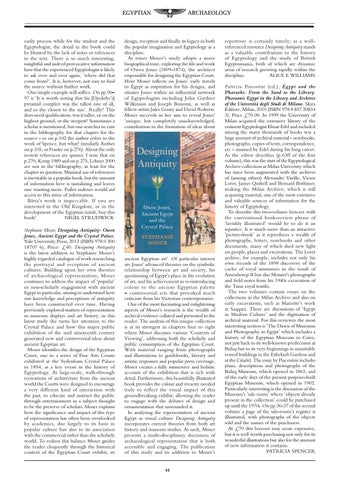
design, reception and finally its legacy in both the popular imagination and Egyptology as a discipline. At times Moser’s study adopts a more biographical tone, exploring the life and work of Owen Jones (1809-1874), the architect responsible for designing the Egyptian Court. Here Moser reflects on Jones’ early travels to Egypt as inspiration for his designs, and situates Jones within an influential network of Egyptologists including John Gardner Wilkinson and Joseph Bonomi, as well as fellow artists Jules Goury and David Roberts. Moser succeeds in her aim to reveal Jones’ ‘unique, but completely unacknowledged, contribution to the formation of ideas about
ancient Egyptian art’. Of particular interest are Jones’ advanced theories on the symbolic relationship between art and society, his questioning of Egypt’s place in the evolution of art, and his achievement in re-introducing colour to the ancient Egyptian palette – controversial acts that provoked much criticism from his Victorian contemporaries. One of the most fascinating and enlightening aspects of Moser’s research is the wealth of archival evidence collated and presented to the reader. The analysis of this unique collection is at its strongest in chapters four to eight where Moser discusses various ‘Contexts of Viewing’, addressing both the scholarly and public consumption of the Egyptian Court. With material ranging from photographs and illustrations to guidebooks, literary and artistic responses and popular press coverage, Moser creates a fully immersive and holistic account of the exhibition that is rich with detail. Furthermore, this beautifully illustrated book provides the colour and vivacity needed truly to reflect the visual impact of this groundbreaking exhibit, allowing the reader to engage with the debates of design and ornamentation that surrounded it. In analysing the representation of ancient Egypt as visual culture Designing Antiquity incorporates current theories from both art history and museum studies. As such, Moser presents a multi-disciplinary discussion of archaeological representation that is both accessible and engaging. The publication of this study and its addition to Moser’s 44
repertoire is certainly timely; as a wellreferenced resource Designing Antiquity stands as a valuable contribution to the history of Egyptology and the study of British Egyptomania, both of which are dynamic areas of research growing rapidly within the discipline. ALICE E WILLIAMS Patrizia Piacentini (ed.), Egypt and the Pharaohs. From the Sand to the Library. Pharaonic Egypt in the Library and Archives of the Università degli Studi di Milano. Skira Editore, Milan, 2010 (ISBN 978 8 857 20834 3). Price £70.00. In 1999 the University of Milan acquired the extensive library of the eminent Egyptologist Elmar Edel and included among the many thousands of books was a large amount of archival material - notebooks, photographs, copies of texts, correspondence, etc - amassed by Edel during his long career. As the editor describes (p.63ff of the first volume), this was the start of the Egyptological Archive collection at Milan University which has since been augmented with the archives of (among others) Alexandre Varille, Victor Loret, James Quibell and Bernard Bothmer, making the Milan Archive, which is still acquiring material, one of the most extensive and valuable sources of information for the history of Egyptology. To describe this two-volume box-set with the conventional book-review phrase of ‘lavishly illustrated’ would be to do it an injustice. It is much more than an attractive ‘picture-book’ as it reproduces a wealth of photographs, letters, notebooks and other documents, many of which shed new light on people, places and excavations. The Loret archive, for example, includes not only his own records of the 1898 discovery of the cache of royal mummies in the tomb of Amenhotep II but also Montet’s photographs and field notes from his 1940s excavation of the Tanis royal tombs. The two volumes contain essays on the collections in the Milan Archive and also on early excavations, such as Mariette’s work at Saqqara. There are discussions of ‘Egypt in Modern Culture’ and the digitisation of archival material. For this reviewer the most interesting section is ‘The Dawn of Museums and Photography in Egypt’ which includes a history of the Egyptian Museum in Cairo, not just back to its well-known predecessor at Bulaq but to its very beginnings in unsuitable reused buildings in the Ezbekieh Gardens and at the Citadel. The essay by Piacentini includes plans, descriptions and photographs of the Bulaq Museum, which opened in 1863, and of the early days of the present purpose-built Egyptian Museum, which opened in 1902. Particularly interesting is the discussion of the Museum’s ‘sale room’ where ‘objects already present in the collection’ could be purchased up until the 1970s. On pp.36-37 of the second volume a page of the sale-room’s register is illustrated, with photographs of the objects sold and the names of the purchasers. At £70 this box-set may seem expensive, but it is well worth purchasing not only for its wonderful illustrations but also for the amount of new information it contains. PATRICIA SPENCER