EGYPTIAN
ARCHAEOLOGY
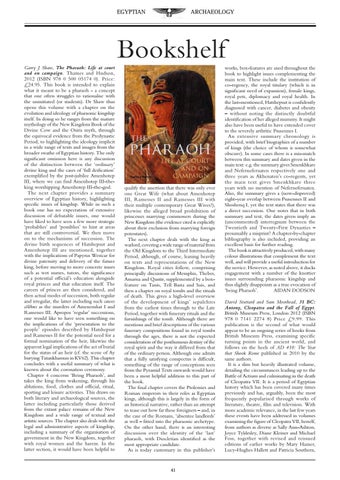
Bookshelf Garry J Shaw, The Pharaoh: Life at court and on campaign. Thames and Hudson, 2012 (ISBN 978 0 500 05174 0). Price: £24.95. This book is intended to explain what it meant to be a pharaoh - a concept that one often struggles to rationalise with the uninitiated (or students). Dr Shaw thus opens this volume with a chapter on the evolution and ideology of pharaonic kingship itself. In doing so he ranges from the mature mythology of the New Kingdom Book of the Divine Cow and the Osiris myth, through the equivocal evidence from the Predynastic Period, to highlighting the ideology implicit in a wide range of texts and images from the broader swathe of Egyptian history. The only significant omission here is any discussion of the distinction between the ‘ordinary’ divine king and the cases of ‘full deification’ exemplified by the post-jubilee Amenhotep III, where we can find Amenhotep III-theking worshipping Amenhotep III-the-god. The next chapter provides a summary overview of Egyptian history, highlighting specific issues of kingship. While in such a book one has no expectation of extensive discussion of debatable issues, one would have liked to have seen a few more strategic ‘probablies’ and ‘possiblies’ to hint at areas that are still controversial. We then move on to the mechanisms of succession. The divine birth sequences of Hatshepsut and Amenhotep III are mentioned, together with the implications of Papyrus Westcar for divine paternity and delivery of the future king, before moving to more concrete issues such as wet nurses, tutors, the significance of a potential official’s education alongside royal princes and that education itself. The careers of princes are then considered, and then actual modes of succession, both regular and irregular, the latter including such causes célèbres as the murders of Amenemhat I and Ramesses III. Apropos ‘regular’ successions, one would like to have seen something on the implications of the ‘presentation to the people’ episodes described by Hatshepsut and Ramesses II for the potential need for a formal nomination of the heir, likewise the apparent legal implications of the act of burial for the status of an heir (cf. the scene of Ay burying Tutankhamun in KV62). This chapter concludes with a useful summary of what is known about the coronation ceremony. Chapter 4 concerns ‘Being Pharaoh’, and takes the king from wakening, through his ablutions, food, clothes and official, ritual, sporting and leisure activities. This draws on both literary and archaeological sources, the latter including particularly those derived from the extant palace remains of the New Kingdom and a wide range of textual and artistic sources. The chapter also deals with the legal and administrative aspects of kingship, including a summary of the organisation of government in the New Kingdom, together with royal women and the harem. In the latter section, it would have been helpful to
qualify the assertion that there was only ever one Great Wife (what about Amenhotep III, Ramesses II and Ramesses III with their multiple contemporary Great Wives?), likewise the alleged broad prohibition of princesses marrying commoners during the New Kingdom (the evidence cited is explicitly about their exclusion from marrying foreign potentates). The next chapter deals with the king as warlord, covering a wide range of material from the Old Kingdom to the Third Intermediate Period, although, of course, leaning heavily on texts and representations of the New Kingdom. Royal cities follow, comprising principally discussions of Memphis, Thebes, Amarna and Qantir, supplemented by a boxfeature on Tanis, Tell Basta and Sais, and then a chapter on royal tombs and the rituals of death. This gives a high-level overview of the development of kings’ sepulchres from the earliest times through to the Late Period, together with funerary rituals and the furnishings of the tomb. Although there are mentions and brief descriptions of the various funerary compositions found in royal tombs through the ages, there is not the expected consideration of the posthumous destiny of the royal spirit and the way it differed from that of the ordinary person. Although one admits that a fully satisfying conspectus is difficult, something of the range of conceptions seen from the Pyramid Texts onwards would have been a most helpful addition to this part of the book. The final chapter covers the Ptolemies and Roman emperors in their roles as Egyptian kings, although this is largely in the form of an historical narrative, rather than an attempt to tease out how far these foreigners – and, in the case of the Romans, ‘absentee landlords’ as well – fitted into the pharaonic archetype. On the other hand, there is an interesting discussion over the identity of the ‘last’ pharaoh, with Diocletian identified as the most appropriate candidate. As is today customary in this publisher’s
41
works, box-features are used throughout the book to highlight issues complementing the main text. These include the institution of co-regency, the royal titulary (which is in significant need of expansion), female kings, royal pets, diplomacy and royal health. In the last-mentioned, Hatshepsut is confidently diagnosed with cancer, diabetes and obesity – without noting the distinctly doubtful identification of her alleged mummy. It might also have been useful to have extended cover to the severely arthritic Psusennes I. An extensive summary chronology is provided, with brief biographies of a number of kings (the choice of whom is somewhat obscure). In some cases there is a mis-match between this summary and dates given in the main text: e.g. the summary gives Smenkhkare and Neferneferuaten respectively one and three years as Akhenaten’s co-regents, yet the main text gives Smenkhkare three years with no mention of Neferneferuaten. Also, the summary gives a (now-disproved) eight-year overlap between Psusennes II and Shoshenq I, yet the text states that there was a direct succession. One notes that in both summary and text, the dates given imply an (uncommented) interregnum between the Twentieth and Twenty-First Dynasties – presumably a misprint? A chapter-by-chapter bibliography is also included, providing an excellent basis for further reading. The book is attractively produced, with many colour illustrations that complement the text well, and will provide a useful introduction for the novice. However, as noted above, it ducks engagement with a number of the knottier issues surrounding pharaonic kingship and thus slightly disappoints as a true evocation of ‘being Pharaoh’. AIDAN DODSON David Stuttard and Sam Moorhead, 31 BC: Antony, Cleopatra and the Fall of Egypt. British Museum Press, London 2012 (ISBN 978 0 7141 2274 8) Price £9.99. This publication is the second of what would appear to be an ongoing series of books from British Museum Press, examining specific turning points in the ancient world, and follows on the heels of AD 410: The Year that Shook Rome published in 2010 by the same authors. It is a slim but heavily illustrated volume, detailing the circumstances leading up to the Battle of Actium and culminating in the death of Cleopatra VII. It is a period of Egyptian history which has been covered many times previously and has, arguably, been the most frequently popularised through works of literature, theatre, film and television. With more academic relevance, in the last few years these events have been addressed in volumes examining the figure of Cleopatra VII, herself, from authors as diverse as Sally Ann-Ashton, Joyce Tyldesley, Diane Kleiner and Michael Foss, together with revised and reissued editions of earlier works by Mary Hamer, Lucy-Hughes Hallett and Patricia Southern,