EGYPTIAN
ARCHAEOLOGY
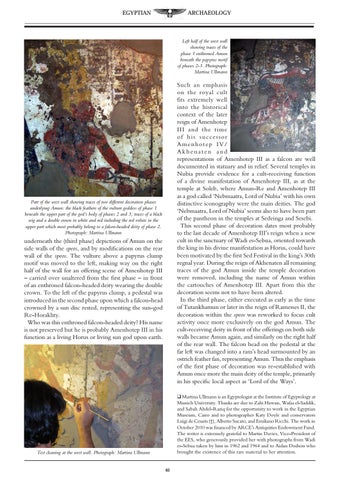
Left half of the west wall showing traces of the phase 1 enthroned Amun beneath the papyrus motif of phases 2-3. Photograph: Martina Ullmann
Such an emphasis on the royal cult fits extremely well into the historical context of the later reign of Amenhotep III and the time of his successor Amenhotep IV/ Akhenaten and representations of Amenhotep III as a falcon are well documented in statuary and in relief. Several temples in Nubia provide evidence for a cult-receiving function of a divine manifestation of Amenhotep III, as at the temple at Soleb, where Amun-Re and Amenhotep III as a god called ‘Nebmaatra, Lord of Nubia’ with his own distinctive iconography were the main deities. The god ‘Nebmaatra, Lord of Nubia’ seems also to have been part of the pantheon in the temples at Sedeinga and Sesebi. This second phase of decoration dates most probably to the last decade of Amenhotep III’s reign when a new cult in the sanctuary of Wadi es-Sebua, oriented towards the king in his divine manifestation as Horus, could have been motivated by the first Sed Festival in the king’s 30th regnal year. During the reign of Akhenaten all remaining traces of the god Amun inside the temple decoration were removed, including the name of Amun within the cartouches of Amenhotep III. Apart from this the decoration seems not to have been altered. In the third phase, either executed as early as the time of Tutankhamun or later in the reign of Ramesses II, the decoration within the speos was reworked to focus cult activity once more exclusively on the god Amun. The cult-receiving deity in front of the offerings on both side walls became Amun again, and similarly on the right half of the rear wall. The falcon head on the pedestal at the far left was changed into a ram’s head surmounted by an ostrich feather fan, representing Amun. Thus the emphasis of the first phase of decoration was re-established with Amun once more the main deity of the temple, primarily in his specific local aspect as ‘Lord of the Ways’.
Part of the west wall showing traces of two different decoration phases underlying Amun: the black feathers of the vulture goddess of phase 1 beneath the upper part of the god’s body of phases 2 and 3; traces of a black wig and a double crown in white and red including the red volute in the upper part which most probably belong to a falcon-headed deity of phase 2. Photograph: Martina Ullmann
underneath the (third phase) depictions of Amun on the side walls of the speos, and by modifications on the rear wall of the speos. The vulture above a papyrus clump motif was moved to the left, making way on the right half of the wall for an offering scene of Amenhotep III – carried over unaltered from the first phase – in front of an enthroned falcon-headed deity wearing the double crown. To the left of the papyrus clump, a pedestal was introduced in the second phase upon which a falcon-head crowned by a sun disc rested, representing the sun-god Re-Horakhty. Who was this enthroned falcon-headed deity? His name is not preserved but he is probably Amenhotep III in his function as a living Horus or living sun god upon earth.
q Martina Ullmann is an Egyptologist at the Institute of Egyptology at Munich University. Thanks are due to Zahi Hawass, Wafaa el-Saddik, and Sabah Abdel-Raziq for the opportunity to work in the Egyptian Museum, Cairo and to photographer Katy Doyle and conservators Luigi de Cesaris (†), Alberto Sucato, and Emiliano Ricchi. The work in October 2010 was financed by ARCE’s Antiquities Endowment Fund. The writer is extremely grateful to Martin Davies, Vice-President of the EES, who generously provided her with photographs from Wadi es-Sebua taken by him in 1962 and 1964 and to Aidan Dodson who brought the existence of this rare material to her attention.
Test cleaning at the west wall. Photograph: Martina Ullmann 40