EGYPTIAN
ARCHAEOLOGY
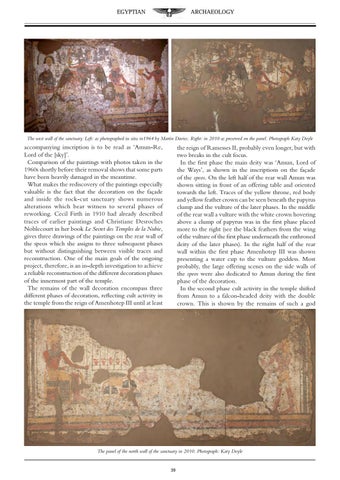
The west wall of the sanctuary. Left: as photographed in situ in1964 by Martin Davies. Right: in 2010 as preserved on the panel. Photograph Katy Doyle
accompanying inscription is to be read as ‘Amun-Re, Lord of the [sky]’. Comparison of the paintings with photos taken in the 1960s shortly before their removal shows that some parts have been heavily damaged in the meantime. What makes the rediscovery of the paintings especially valuable is the fact that the decoration on the façade and inside the rock-cut sanctuary shows numerous alterations which bear witness to several phases of reworking. Cecil Firth in 1910 had already described traces of earlier paintings and Christiane Desroches Noblecourt in her book Le Secret des Temples de la Nubie, gives three drawings of the paintings on the rear wall of the speos which she assigns to three subsequent phases but without distinguishing between visible traces and reconstruction. One of the main goals of the ongoing project, therefore, is an in-depth investigation to achieve a reliable reconstruction of the different decoration phases of the innermost part of the temple. The remains of the wall decoration encompass three different phases of decoration, reflecting cult activity in the temple from the reign of Amenhotep III until at least
the reign of Ramesses II, probably even longer, but with two breaks in the cult focus. In the first phase the main deity was ‘Amun, Lord of the Ways’, as shown in the inscriptions on the façade of the speos. On the left half of the rear wall Amun was shown sitting in front of an offering table and oriented towards the left. Traces of the yellow throne, red body and yellow feather crown can be seen beneath the papyrus clump and the vulture of the later phases. In the middle of the rear wall a vulture with the white crown hovering above a clump of papyrus was in the first phase placed more to the right (see the black feathers from the wing of the vulture of the first phase underneath the enthroned deity of the later phases). In the right half of the rear wall within the first phase Amenhotep III was shown presenting a water cup to the vulture goddess. Most probably, the large offering scenes on the side walls of the speos were also dedicated to Amun during the first phase of the decoration. In the second phase cult activity in the temple shifted from Amun to a falcon-headed deity with the double crown. This is shown by the remains of such a god
The panel of the north wall of the sanctuary in 2010. Photograph: Katy Doyle 39