EGYPTIAN
ARCHAEOLOGY
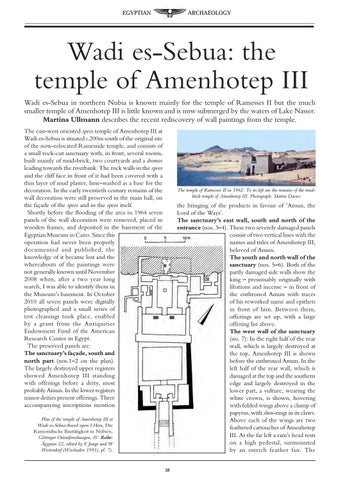
Wadi es-Sebua: the temple of Amenhotep III Wadi es-Sebua in northern Nubia is known mainly for the temple of Ramesses II but the much smaller temple of Amenhotep III is little known and is now submerged by the waters of Lake Nasser. Martina Ullmann describes the recent rediscovery of wall paintings from the temple. The east-west oriented speos temple of Amenhotep III at Wadi es-Sebua is situated c.200m south of the original site of the now-relocated Ramesside temple, and consists of a small rock-cut sanctuary with, in front, several rooms, built mainly of mud-brick, two courtyards and a dromos leading towards the riverbank. The rock walls in the speos and the cliff face in front of it had been covered with a thin layer of mud plaster, lime-washed as a base for the decoration. In the early twentieth century remains of the wall decoration were still preserved in the main hall, on the façade of the speos and in the speos itself. Shortly before the flooding of the area in 1964 seven panels of the wall decoration were removed, placed in wooden frames, and deposited in the basement of the Egyptian Museum in Cairo. Since this operation had never been properly documented and published, the knowledge of it became lost and the whereabouts of the paintings were not generally known until November 2008 when, after a two year long search, I was able to identify them in the Museum’s basement. In October 2010 all seven panels were digitally photographed and a small series of test cleanings took place, enabled by a grant from the Antiquities Endowment Fund of the American Research Center in Egypt. The preserved panels are: The sanctuary’s façade, south and north part (nos.1–2 on the plan). The largely destroyed upper registers showed Amenhotep III standing with offerings before a deity, most probably Amun. In the lower registers minor deities present offerings. Three accompanying inscriptions mention
The temple of Ramesses II in 1962. To its left are the remains of the mudbrick temple of Amenhotep III. Photograph: Martin Davies
the bringing of the products in favour of ‘Amun, the Lord of the Ways’. The sanctuary’s east wall, south and north of the entrance (nos. 3–4). These two severely damaged panels consist of two vertical lines with the names and titles of Amenhotep III, beloved of Amun. The south and north wall of the sanctuary (nos. 5–6). Both of the partly damaged side walls show the king – presumably originally with libations and incense – in front of the enthroned Amun with traces of his reworked name and epithets in front of him. Between them, offerings are set up, with a large offering list above. The west wall of the sanctuary (no. 7): In the right half of the rear wall, which is largely destroyed at the top, Amenhotep III is shown before the enthroned Amun. In the left half of the rear wall, which is damaged at the top and the southern edge and largely destroyed in the lower part, a vulture, wearing the white crown, is shown, hovering with folded wings above a clump of papyrus, with shen-rings in its claws. Above each of the wings are two feathered cartouches of Amenhotep III. At the far left a ram’s head rests on a high pedestal, surmounted by an ostrich feather fan. The
Plan of the temple of Amenhotep III at Wadi es-Sebua (based upon I Hein, Die Ramessidische Bautätigkeit in Nubien, Göttinger Orientforschungen, IV. Reihe: ������� Ägypten 22, edited by F Junge and W Westendorf (Wiesbaden 1991), pl. 7).
38