EGYPTIAN
ARCHAEOLOGY
Topographic 3D map of the Apries Palace
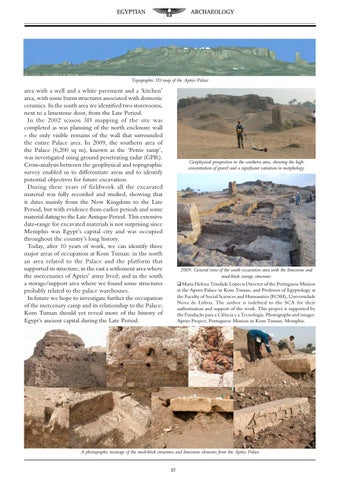
area with a well and a white pavement and a ‘kitchen’ area, with some burnt structures associated with domestic ceramics. In the south area we identified two storerooms, next to a limestone door, from the Late Period. In the 2002 season 3D mapping of the site was completed as was planning of the north enclosure wall - the only visible remains of the wall that surrounded the entire Palace area. In 2009, the southern area of the Palace (6,200 sq m), known as the ‘Petrie ramp’, was investigated using ground penetrating radar (GPR). Cross-analysis between the geophysical and topographic survey enabled us to differentiate areas and to identify potential objectives for future excavation. During these years of fieldwork all the excavated material was fully recorded and studied, showing that it dates mainly from the New Kingdom to the Late Period, but with evidence from earlier periods and some material dating to the Late Antique Period. This extensive date-range for excavated materials is not surprising since Memphis was Egypt’s capital city and was occupied throughout the country’s long history. Today, after 10 years of work, we can identify three major areas of occupation at Kom Tuman: in the north an area related to the Palace and the platform that supported its structure; in the east a settlement area where the mercenaries of Apries’ army lived; and in the south a storage/support area where we found some structures probably related to the palace warehouses. In future we hope to investigate further the occupation of the mercenary camp and its relationship to the Palace; Kom Tuman should yet reveal more of the history of Egypt’s ancient capital during the Late Period.
Geophysical prospection in the southern area, showing the high concentration of gravel and a significant variation in morphology
2009. General view of the south excavation area with the limestone and mud-brick storage structures q Maria Helena Trindade Lopes is Director of the Portuguese Mission at the Apries Palace in Kom Tuman, and Professor of Egyptology at the Faculty of Social Sciences and Humanities (FCSH), Universidade Nova de Lisboa. The author is indebted to the SCA for their authorisation and support of the work. This project is supported by the Fundação para a Ciência e a Tecnologia. Photographs and images: Apries Project, Portuguese Mission in Kom Tuman, Memphis.
A photographic montage of the mud-brick structures and limestone elements from the Apries Palace 37