EGYPTIAN
ARCHAEOLOGY
Mummy of an ibis, with image of the god Thoth. Acc. No.11501. From the EES excavations at Saqqara. Photograph © Paul Cliff
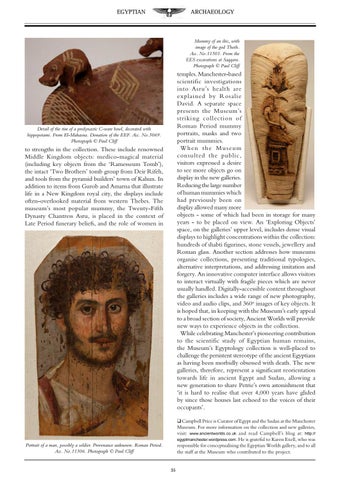
temples. Manchester-based scientific investigations into Asru’s health are explained by Rosalie David. A separate space presents the Museum’s striking collection of Roman Period mummy portraits, masks and two portrait mummies. When the Museum consulted the public, visitors expressed a desire to see more objects go on display in the new galleries. Reducing the large number of human mummies which had previously been on display allowed many more objects - some of which had been in storage for many years - to be placed on view. An ‘Exploring Objects’ space, on the galleries’ upper level, includes dense visual displays to highlight concentrations within the collection: hundreds of shabti figurines, stone vessels, jewellery and Roman glass. Another section addresses how museums organise collections, presenting traditional typologies, alternative interpretations, and addressing imitation and forgery. An innovative computer interface allows visitors to interact virtually with fragile pieces which are never usually handled. Digitally-accessible content throughout the galleries includes a wide range of new photography, video and audio clips, and 360o images of key objects. It is hoped that, in keeping with the Museum’s early appeal to a broad section of society, Ancient Worlds will provide new ways to experience objects in the collection. While celebrating Manchester’s pioneering contribution to the scientific study of Egyptian human remains, the Museum’s Egyptology collection is well-placed to challenge the persistent stereotype of the ancient Egyptians as having been morbidly obsessed with death. The new galleries, therefore, represent a significant reorientation towards life in ancient Egypt and Sudan, allowing a new generation to share Petrie’s own astonishment that ‘it is hard to realise that over 4,000 years have glided by since those houses last echoed to the voices of their occupants’.
Detail of the rim of a predynastic C-ware bowl, decorated with hippopotami. From El-Mahasna. Donation of the EEF. Acc. No.5069. Photograph © Paul Cliff
to strengths in the collection. These include renowned Middle Kingdom objects: medico-magical material (including key objects from the ‘Ramesseum Tomb’), the intact ‘Two Brothers’ tomb group from Deir Rifeh, and tools from the pyramid builders’ town of Kahun. In addition to items from Gurob and Amarna that illustrate life in a New Kingdom royal city, the displays include often-overlooked material from western Thebes. The museum’s most popular mummy, the Twenty-Fifth Dynasty Chantress Asru, is placed in the context of Late Period funerary beliefs, and the role of women in
q Campbell Price is Curator of Egypt and the Sudan at the Manchester Museum. For more information on the collection and new galleries, visit: www.ancientworlds.co.uk and read Campbell’s blog at: http:// egyptmanchester.wordpress.com. He is grateful to Karen Exell, who was responsible for conceptualising the Egyptian Worlds gallery, and to all the staff at the Museum who contributed to the project.
Portrait of a man, possibly a soldier. Provenance unknown. Roman Period. Acc. No.11306. Photograph © Paul Cliff 35